I Got Scammed Online: What Should I Do Immediately?
Realising that you have been scammed can be frightening.
You may have sent money to an investment platform, cryptocurrency wallet, online seller, romantic partner, supposed financial adviser or someone impersonating a legitimate organisation.
Your first reaction may be to panic, confront the person or immediately search online for someone who promises to recover the money.
Instead, focus on protecting yourself and preserving the information connected to what happened.
The actions you take shortly after discovering the scam can be important.
This guide explains what to do next.
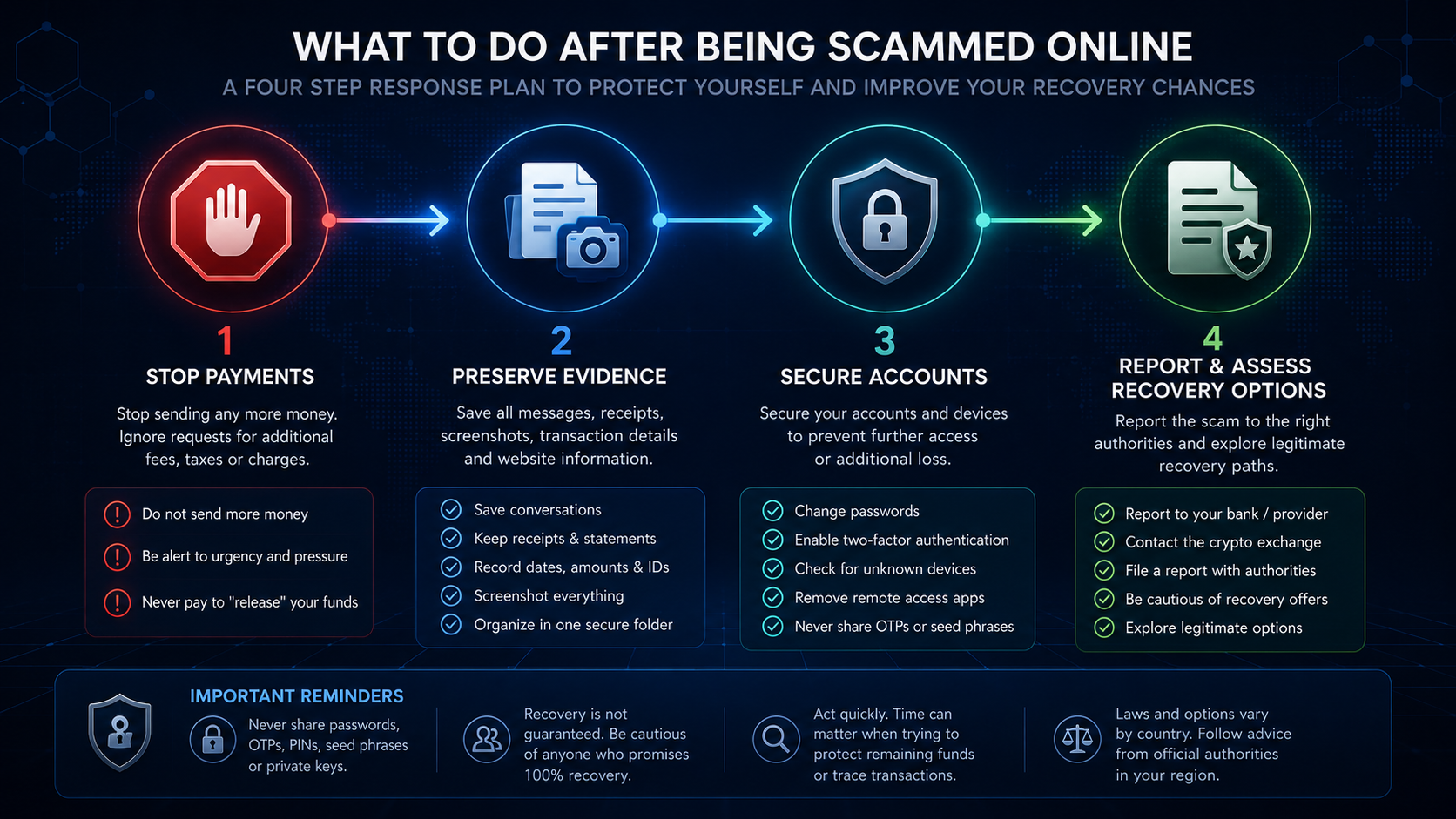
1. Stop Sending Money Immediately
Do not send additional money to the person or platform involved.
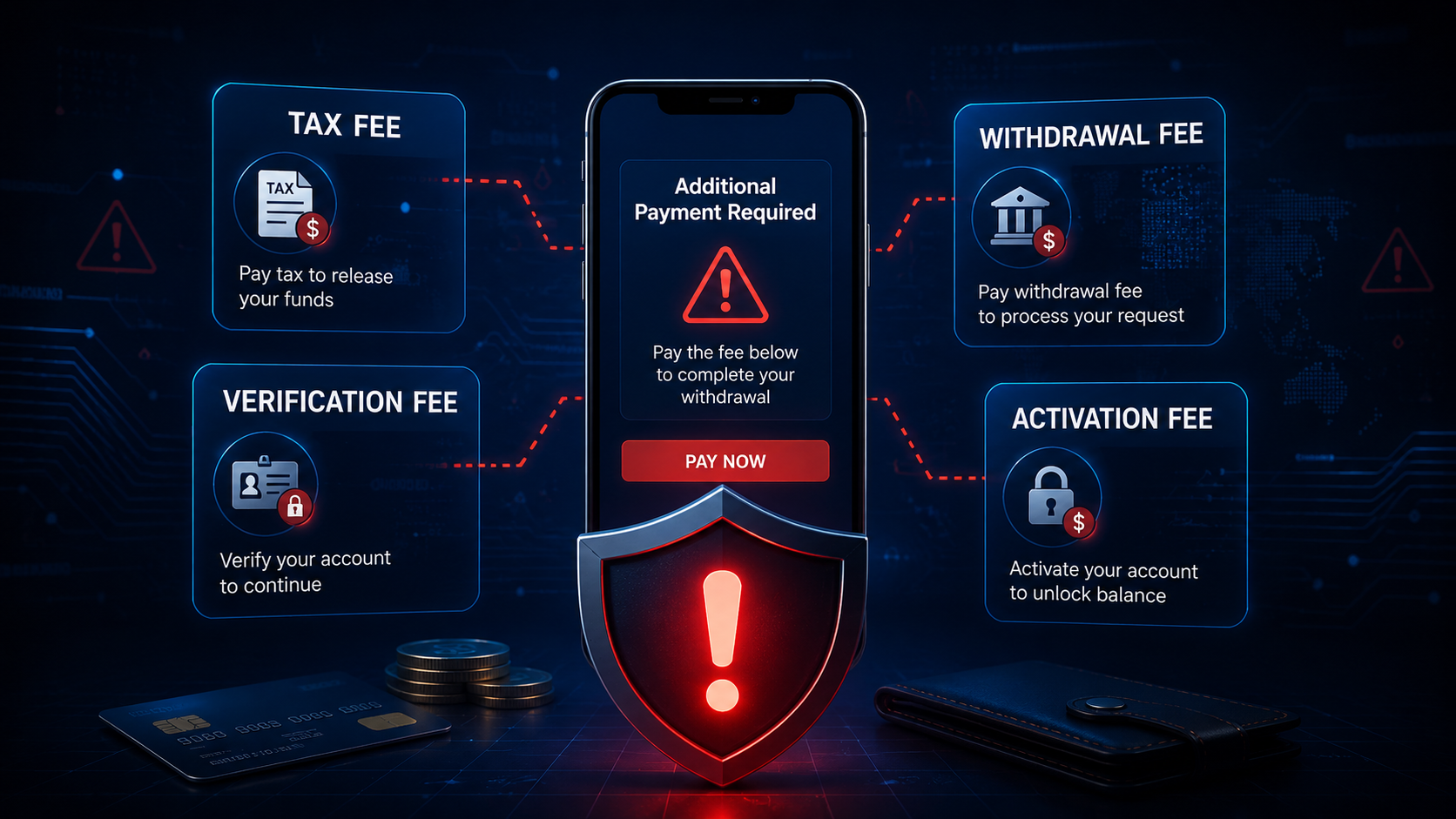
Scammers frequently provide new explanations for why another payment is supposedly required.
You may be told that you need to pay:
• withdrawal fees • taxes • account verification charges • wallet activation fees • security deposits • liquidity fees • legal charges • commissions • cryptocurrency gas fees • anti-money-laundering charges
Be particularly cautious when someone tells you that one final payment will release all of your money.
Legitimate circumstances can involve fees, but unexpected demands for additional payments after you are already unable to withdraw money are a serious warning sign.
Pause further transactions while you independently verify what is happening.
2. Do Not Delete Your Conversations
You might feel angry or embarrassed and want to delete everything connected to the scam.
Don't.
Messages can contain valuable information.
Preserve communications from:
• WhatsApp • Telegram • Instagram • Facebook • email • SMS • dating applications • investment platforms • cryptocurrency exchanges • online marketplaces • other messaging services
Take screenshots where appropriate.
If the platform allows you to export the conversation, consider preserving an exported copy as well.
Record usernames, account names, phone numbers and email addresses.
Do this before blocking the suspected scammer because accounts, messages or profiles may later disappear.
3. Preserve Your Transaction Records
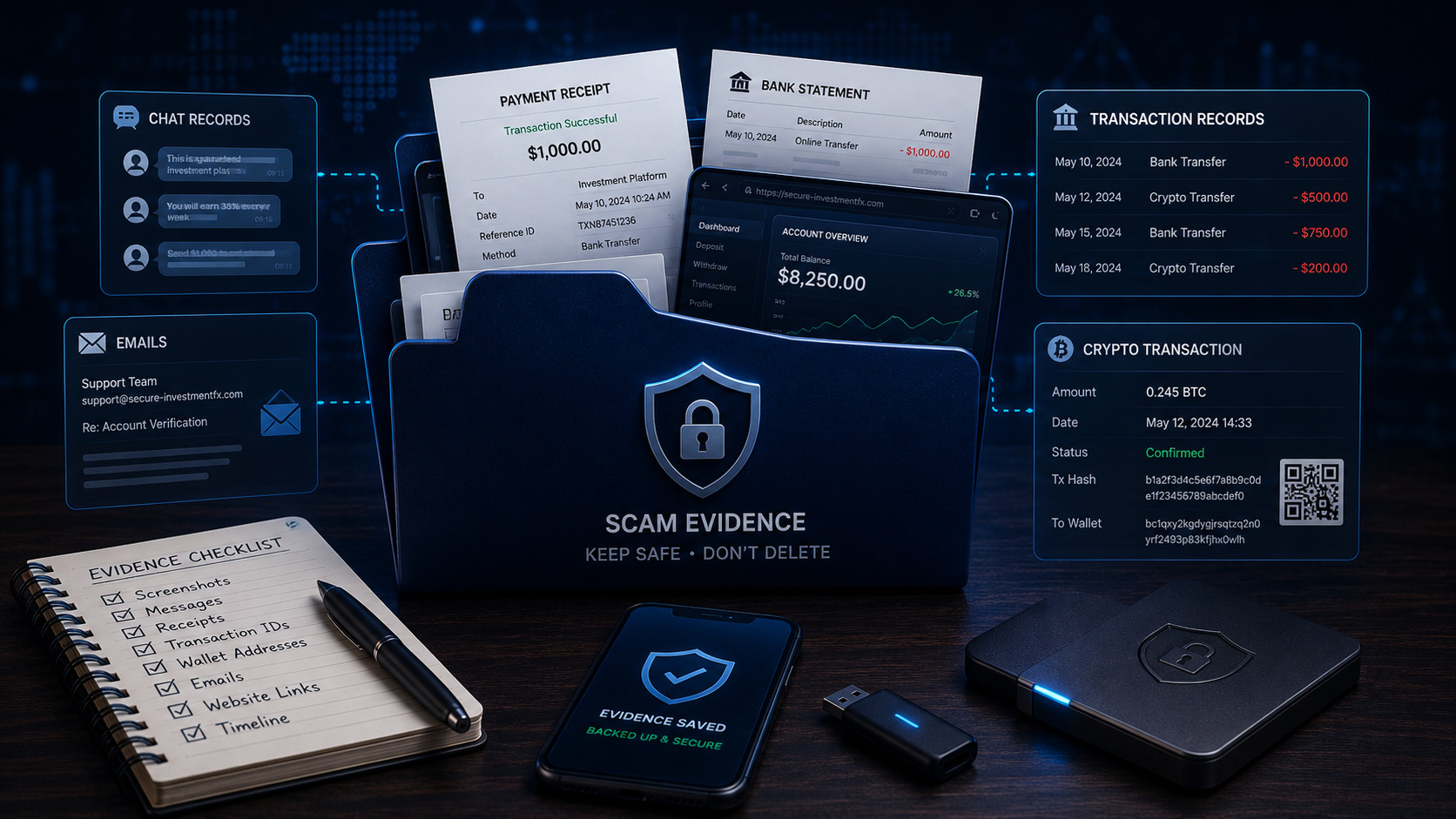
Create a clear record of every payment connected to the incident.
Depending on how you paid, preserve information such as:
• bank statements • payment receipts • transfer references • card transactions • cryptocurrency transaction hashes • wallet addresses • exchange withdrawal records • payment dates • amounts • currencies • recipient information
If cryptocurrency was involved, transaction hashes and wallet addresses can be especially useful because blockchain transactions may remain publicly traceable even when the identity controlling a wallet is unknown.
Do not alter screenshots or transaction records.
Keep the original files whenever possible.
4. Save Information About the Website or Platform
If the scam involved a website, fake trading platform or online investment service, preserve information about it while it is still accessible.
Record:
• website address • company name being used • screenshots of your account • displayed balance • deposit history • withdrawal attempts • error messages • customer-support conversations • contact information • usernames • advertised returns • payment instructions
Fraudulent websites can disappear quickly.
Preserving this information early may make it easier to explain what happened later.
5. Contact Your Bank or Payment Provider
If you transferred money through a bank, debit card, credit card or payment service, contact the provider as quickly as possible.
Explain that you believe the transaction is connected to fraud.
Ask what options are available for the specific payment method.
Depending on the circumstances, the provider may be able to investigate the transaction, attempt a recall, freeze certain activity, open a dispute or explain other available procedures.
Whether money can be returned depends on factors such as the payment method, jurisdiction, transaction status and circumstances.
Do not assume that a transaction can or cannot be reversed without contacting the relevant provider.
Time can matter, so contact them promptly.
6. Secure Your Accounts
If you shared login information with the suspected scammer, secure your accounts immediately.
Change compromised passwords.
Start with important accounts such as:
• email • banking • cryptocurrency exchanges • payment services • social media
Use unique passwords for each account.
Enable two-factor authentication where available.
If you installed remote-access software at someone's request, disconnect the device from sensitive accounts and consider obtaining professional security assistance.
Examples of information you should never provide to someone claiming to help recover your money include:
• passwords • one-time passwords • PINs • seed phrases • private cryptocurrency keys
A cryptocurrency seed phrase or private key can provide control over the associated assets.
Never send it to a supposed investigator, recovery specialist or support agent.
7. Contact the Cryptocurrency Exchange If Crypto Was Involved
If cryptocurrency was sent from an exchange account, contact the exchange's official support service.
Provide the relevant transaction information and explain that the transfer is associated with suspected fraud.
Important information can include:
• transaction hash • receiving wallet address • cryptocurrency • amount • date and time • screenshots • communications
Blockchain transfers are generally difficult to reverse, but reporting quickly may still be important, particularly if funds eventually reach services capable of identifying or restricting account activity.
Never rely on someone who claims that they can simply "hack the blockchain" and return cryptocurrency to your wallet.
8. Write Down the Complete Timeline
Create a timeline while the events are still fresh in your memory.
Start with your first interaction.
Document:
- How you first encountered the person or platform.
- When communication started.
- What they told you.
- When the first payment was made.
- Every additional payment.
- What happened when you attempted to withdraw.
- Any additional fees requested.
- When you realised something was wrong.
- What actions you have already taken.
A structured timeline can make the incident easier to understand when speaking with banks, exchanges, law enforcement, lawyers or other legitimate organisations.
9. Report the Scam to Appropriate Authorities
Consider reporting the incident to the appropriate fraud or law-enforcement authorities in your country.
The appropriate organisation depends on where you live and the type of scam involved.
You may also need to report the incident to:
• your bank • card issuer • payment provider • cryptocurrency exchange • social-media platform • marketplace • website hosting service • relevant financial regulator
Keep copies of reports and reference numbers.
They may become useful later.
10. Be Extremely Careful With Recovery Offers
People who have already lost money can become targets for a second scam.
This is commonly known as a recovery scam.
Someone may contact you claiming that they:
• found your stolen cryptocurrency • work with law enforcement • work with a regulator • are blockchain investigators • are hackers • can freeze a scammer's wallet • can recover 100% of your money • have already recovered your funds
They may then demand an upfront payment.
Be cautious.
Do not send money simply because someone shows you screenshots supposedly proving that your funds have been located.
Do not provide seed phrases, private keys, passwords or one-time codes.
No legitimate organisation can guarantee that every scam loss will be recovered.
11. Don't Let Embarrassment Stop You From Acting
Scams are deliberately designed to manipulate trust, urgency, fear, affection or financial ambition.
Victims can include experienced professionals, investors, business owners and people who are normally very careful online.
Instead of concentrating on embarrassment, concentrate on the information you still have and the actions you can take now.
The sooner you organise the situation, the easier it becomes to understand what happened.
12. Organise Everything Into One Evidence Folder
Create a folder containing copies of all relevant information.
A simple structure might include:
01 — Timeline
02 — Payments
03 — Conversations
04 — Website Screenshots
05 — Wallet Information
06 — Emails
07 — Bank Communications
08 — Reports to Authorities
09 — Other Evidence
Keep original evidence whenever possible.
Consider maintaining a backup in a secure location.
Can Money Lost to an Online Scam Be Recovered?
Sometimes funds can be recovered, but there is no universal answer.
The possibilities depend on factors including:
• how the money was transferred • how quickly action was taken • where the recipient is located • whether financial institutions are involved • whether cryptocurrency was used • where cryptocurrency subsequently moved • whether recipient accounts can be identified • applicable laws and jurisdictions • the evidence available
For this reason, be suspicious of anyone promising guaranteed recovery before properly reviewing what happened.
A responsible assessment should begin with the evidence and transaction history.
How ScamGuide Pro Can Help
ScamGuide Pro provides a structured place to document suspected scams, organise supporting evidence and review possible next steps.
You can submit information including:
• scam type • company or platform • website • phone numbers • social-media accounts • wallet addresses • payment information • transaction details • screenshots • supporting documents
Your case information can then be organised so the circumstances and potential next steps can be reviewed.
Recovery possibilities depend on the individual circumstances of each case.
Think you have been scammed?
Create a private case, organise your evidence and get guidance on the next steps available for your situation.
Button destination: ScamGuide Pro's existing Report a Scam / case submission page.
Quick Checklist: What to Do After Being Scammed
If you have just discovered the scam:
✓ Stop sending additional money.
✓ Preserve conversations.
✓ Save transaction records.
✓ Screenshot the website/platform.
✓ Contact your bank or payment provider.
✓ Secure compromised accounts.
✓ Contact your cryptocurrency exchange where relevant.
✓ Record wallet addresses and transaction hashes.
✓ Create a timeline.
✓ Report the incident to appropriate authorities.
✓ Be cautious of unsolicited recovery offers.
✓ Never provide passwords, OTPs, seed phrases or private keys.
Final Thoughts
Discovering an online scam can be overwhelming, but making rushed decisions can create additional problems.
Stop further payments, secure your accounts and preserve as much evidence as possible.
Then work through the available reporting and recovery options based on how the money was transferred and the circumstances surrounding the incident.
Most importantly, be cautious of anyone who guarantees recovery or demands additional money before providing a clear explanation of what they can legitimately do.
If you want to organise the details of what happened, you can submit a report through ScamGuide Pro and preserve the relevant case information in one place.
Think you have been scammed?
Create a private case, organise your evidence and get guidance on the next steps available for your situation.
Stay alert: legitimate organisations will never ask you for your password, private key, seed phrase or a one-time passcode. If something feels off, stop, verify independently, and avoid sending further funds.
Scam alerts
Stay ahead of new scam tactics
Get practical fraud warnings, new ScamGuard Pro investigations and safety guides delivered to your inbox.
No spam. Unsubscribe anytime.