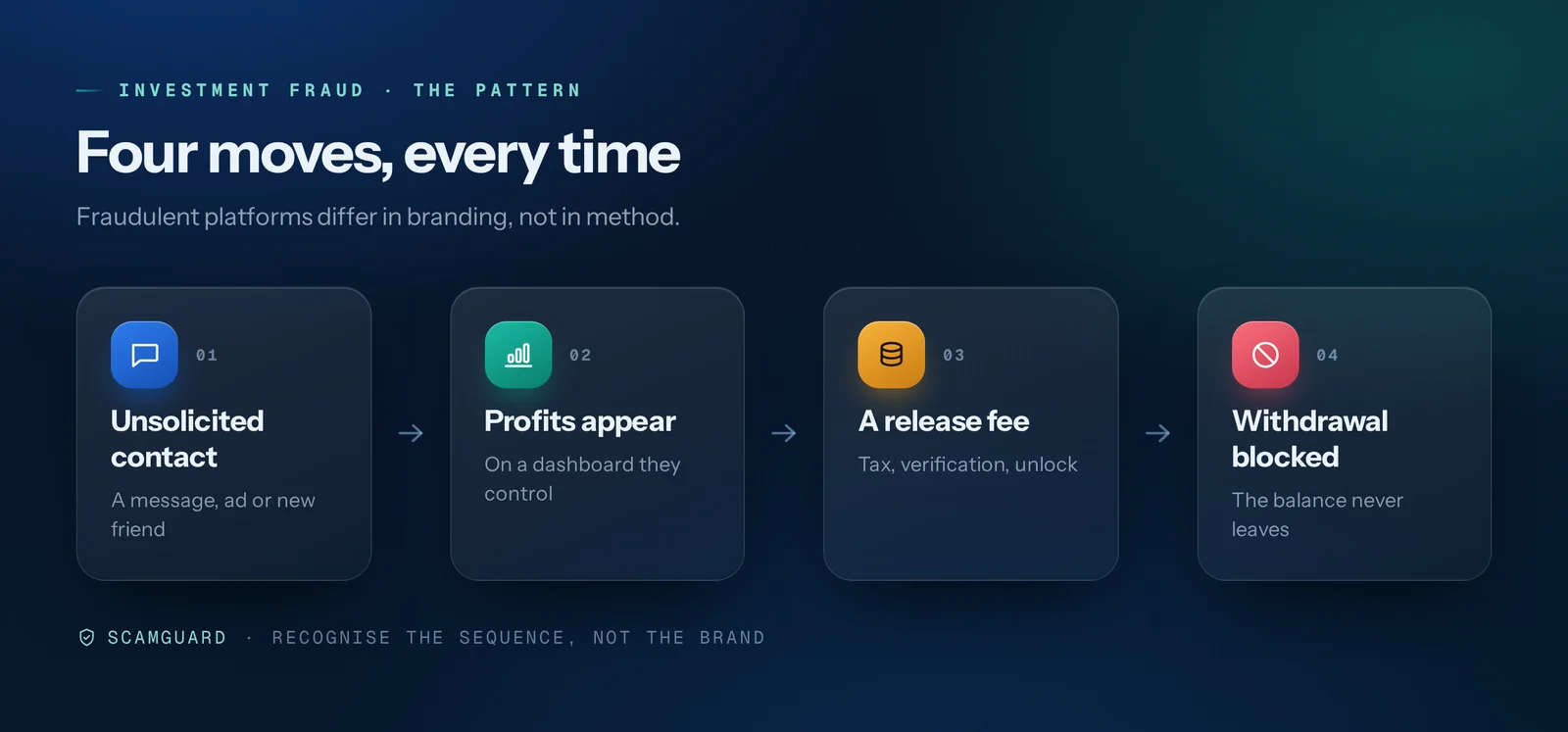
Online investment platforms have never looked more convincing. A modern website, a live-looking dashboard, a friendly "account manager" on WhatsApp or Telegram, and a balance that climbs every day — none of that is proof that your money exists anywhere other than on a screen.
The good news is that fraudulent investment platforms tend to repeat the same behaviours, and most of them can be spotted before you send a single payment. This guide walks through 12 warning signs, gives you a five-minute check you can run before funding an account, and explains what to do if you have already paid.
Not sure about a platform?
Search ScamGuard to see whether other people have already documented the same website, wallet address or "account manager".
12 warning signs of a scam investment platform
No single sign proves fraud on its own. But the more of these you can tick, the more carefully you should treat the platform — and the more reason you have to stop before you pay.
1. Guaranteed or fixed returns
Genuine investments carry risk, and regulated firms are required to say so. Promises of "guaranteed" daily, weekly or monthly profit, fixed percentage returns, or "no-loss" trading are not how markets work. Any figure presented as certain is a marketing claim, not an investment.
2. Pressure to act immediately
Scam platforms manufacture urgency: a closing "allocation", a bonus that expires tonight, a price that will "never be this low again". Pressure exists to stop you checking. A legitimate opportunity survives you taking 48 hours to research it.
3. A dashboard that shows profits but proves nothing
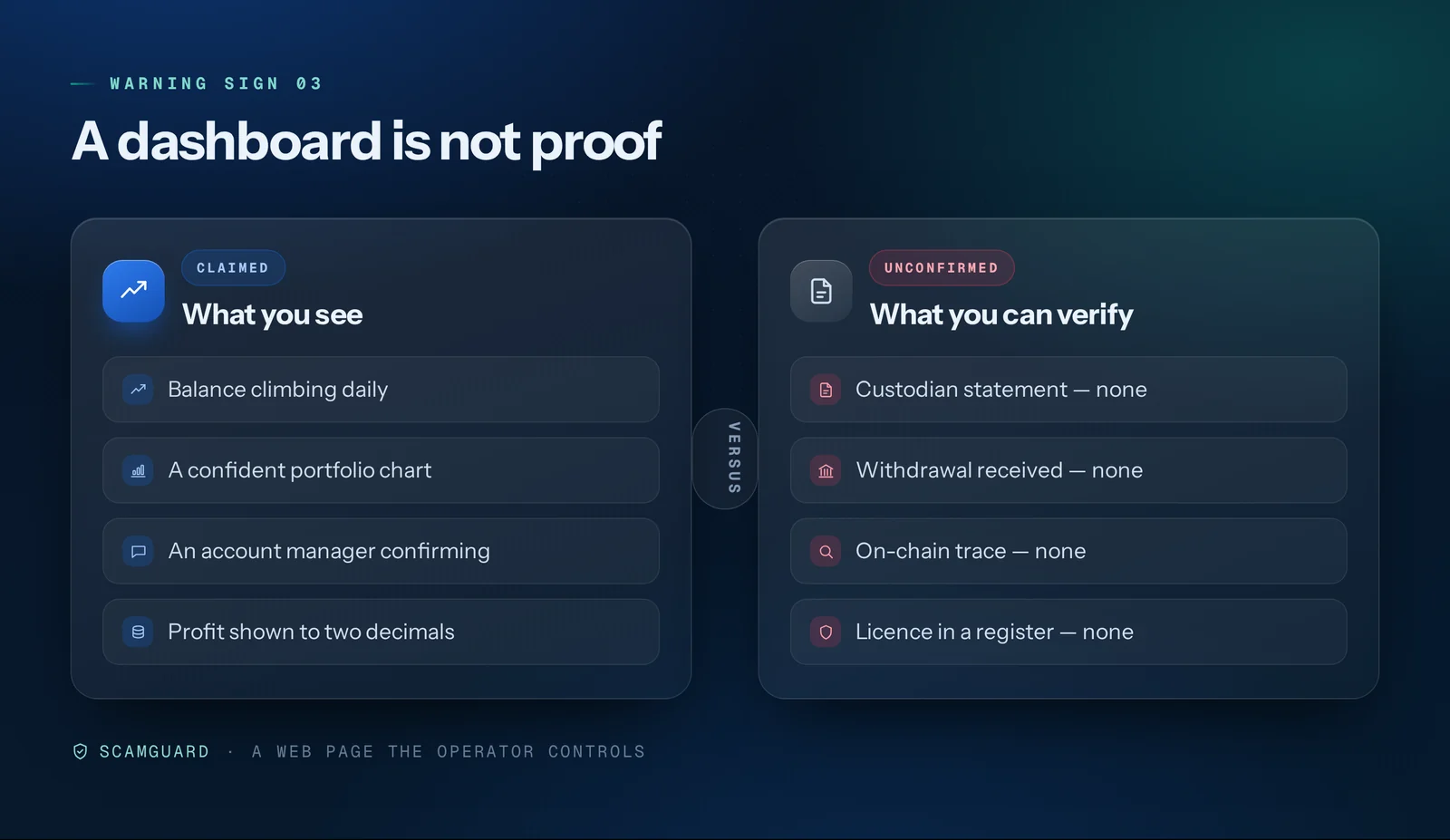
A trading dashboard is just a web page the operator controls. Rising balances, trade histories and portfolio charts can all be typed into a database. Ask yourself what independent evidence you have that the money exists: a statement from a regulated custodian, an on-chain transaction you can verify yourself, or a withdrawal that actually arrived.
4. Withdrawals that stall, fail or need "approval"
This is the single clearest sign. Deposits work instantly; withdrawals get stuck in verification, "compliance review", "system maintenance" or a queue that never moves. Test small and test early — if a modest withdrawal cannot be completed, treat the whole balance as unavailable.
5. Surprise fees before you can withdraw
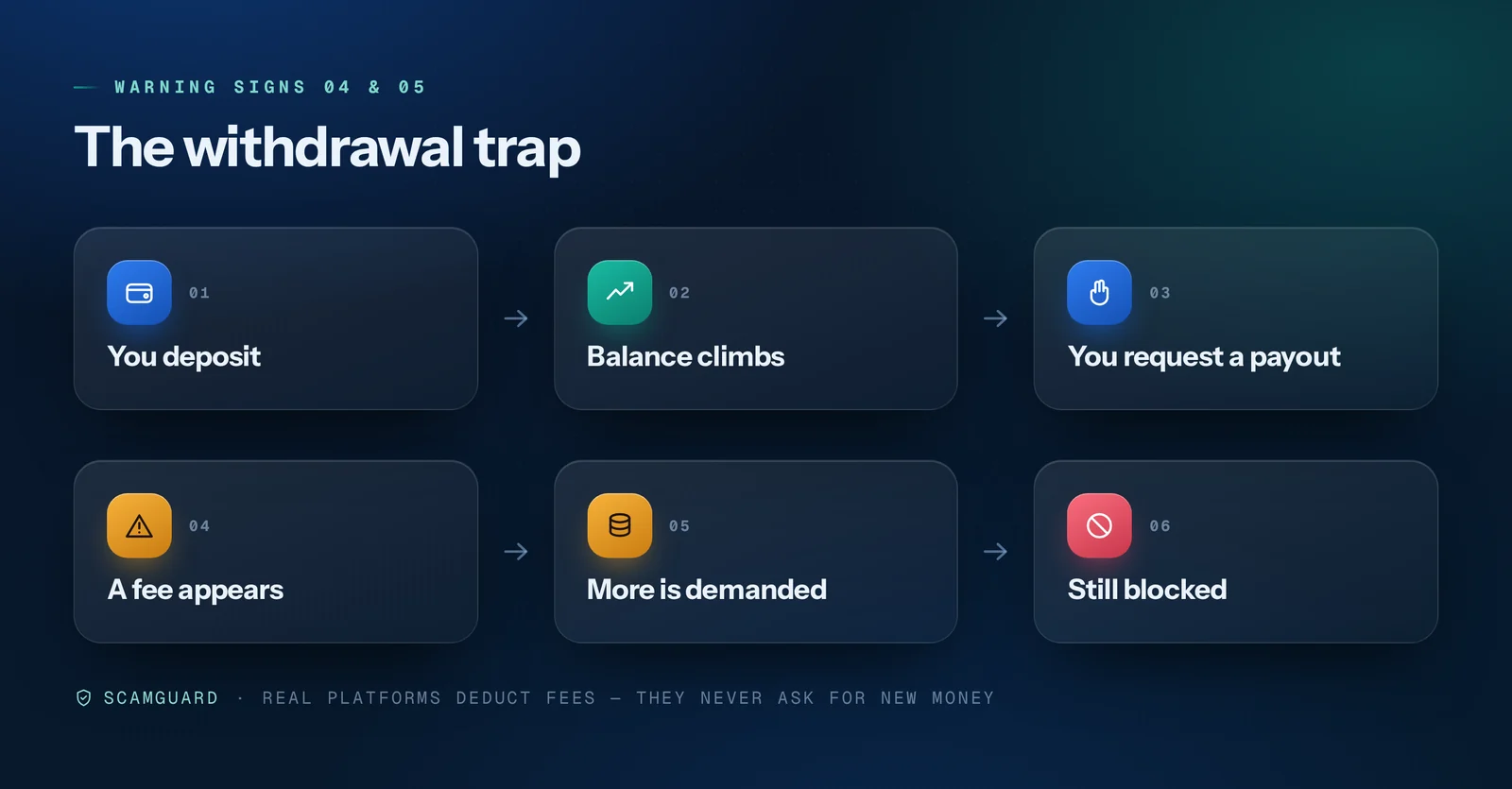
Withdrawal tax, liquidity fee, anti-money-laundering deposit, insurance bond, "unlock" payment — the names vary, the pattern does not. You are asked to send more money to release money you supposedly already have. Legitimate platforms deduct fees from your balance; they do not require fresh deposits to let you out.
6. Company details you cannot verify
Look for a full legal name, company registration number, registered address and regulator licence number. Then check them independently in the relevant company register and regulator database — do not trust a licence number printed on the site itself. Missing, vague or unverifiable details are a serious problem.
7. Suspicious domains and clone branding
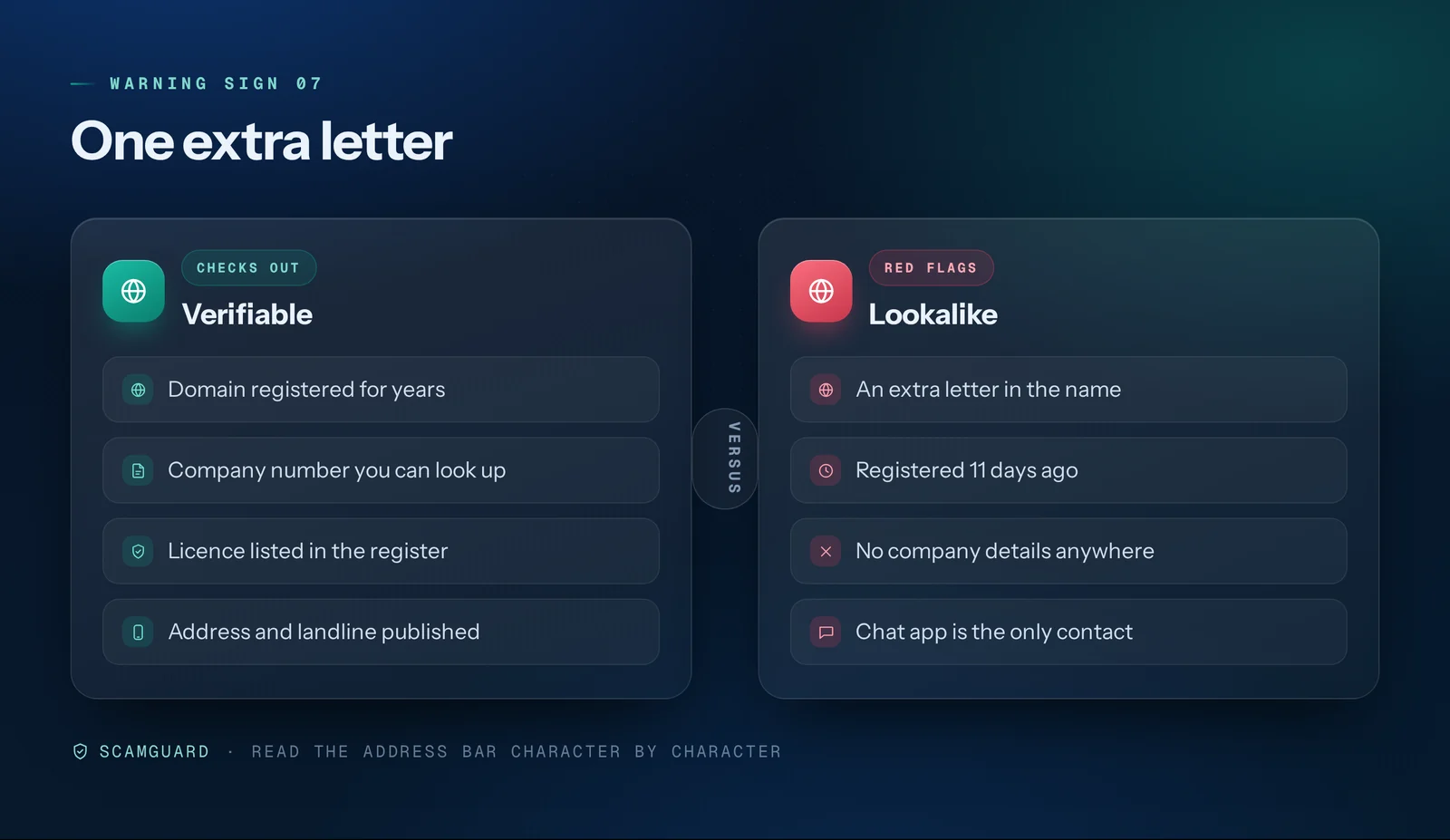
Recently registered domains, near-copies of a well-known firm's name, odd extensions, or a site that mirrors a real broker with one letter changed. Also check for a working contact address, real support channels, and pages that actually load rather than placeholder text.
8. An "investment manager" who found you first
Unsolicited contact on WhatsApp, Telegram, Instagram, dating apps or a "wrong number" text that turns friendly is one of the most common entry points. If the relationship started with them approaching you, and it moves toward an investment platform, treat every claim as unverified.
9. Reviews that all sound the same
Batches of five-star reviews posted in a short window, generic wording, stock-photo profile pictures, testimonials only on the platform's own site, or a Telegram channel full of screenshots of "payouts". Look for detailed, critical and independent accounts instead — and search the platform name alongside words like "withdrawal" or "complaint".
10. Unusual payment methods
Requests to pay by cryptocurrency transfer to a personal wallet, gift cards, money-transfer services, or bank transfers to an individual rather than the registered company. These routes are chosen because they are fast and hard to reverse.
11. Discouraging you from checking
Being told not to tell your bank the real reason for a transfer, to describe it as a family payment, to keep the opportunity private, or that your family "won't understand" is a control tactic. Honest firms are comfortable with you asking questions and taking advice.
12. A balance you cannot turn into money
Ultimately, every warning sign above leads here. If the only place your profit exists is a number on their platform, and no part of it has ever reached your own bank account or wallet, you do not have an investment — you have a claim against people you cannot identify.
Think you have been scammed?
Create a private case, organise your evidence and get guidance on the next steps available for your situation.
Before you send money: a 5-minute scam check
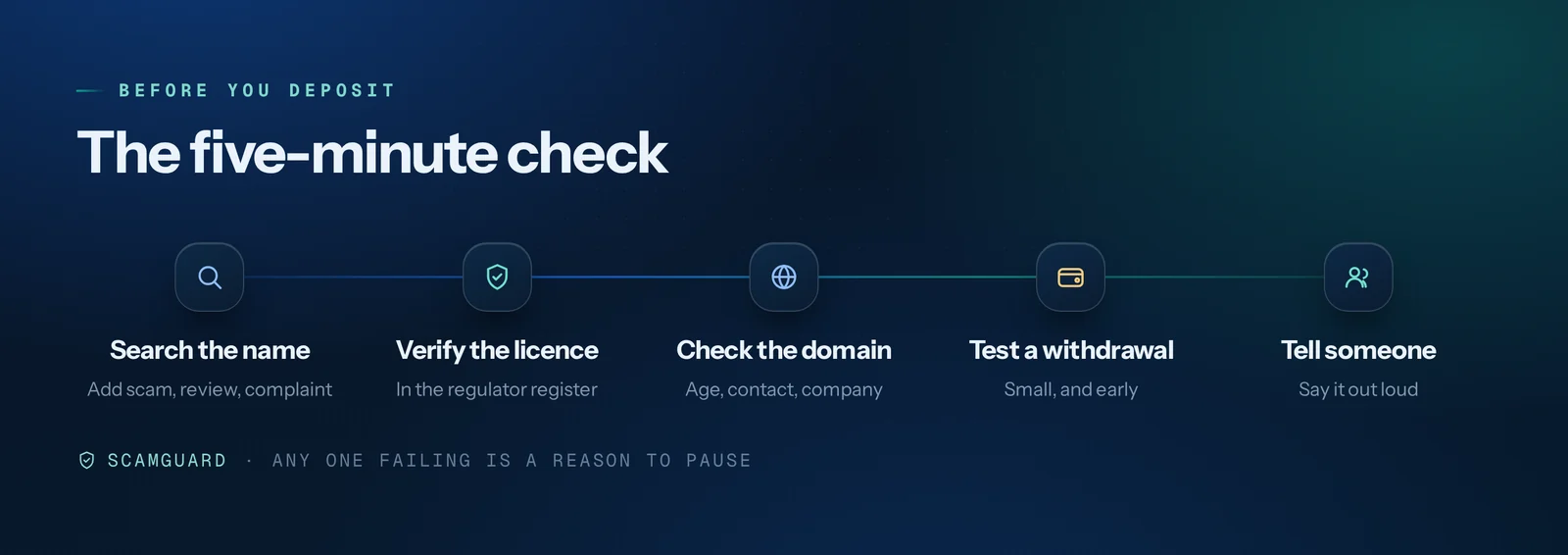
Run this before your first deposit — and again before any additional payment.
- Search the name. Look up the platform, domain, wallet address and the person contacting you on ScamGuard and in a normal web search.
- Verify the licence. Find the firm in your national regulator's public register using the regulator's own website, not a link the platform gave you.
- Check the domain age and contact details. A brand-new domain with no verifiable address or phone support deserves scepticism.
- Test a withdrawal. Deposit the minimum, then withdraw part of it before committing anything meaningful.
- Tell one person. Describe the opportunity honestly to someone you trust. If you feel you must hide it, that is the answer.
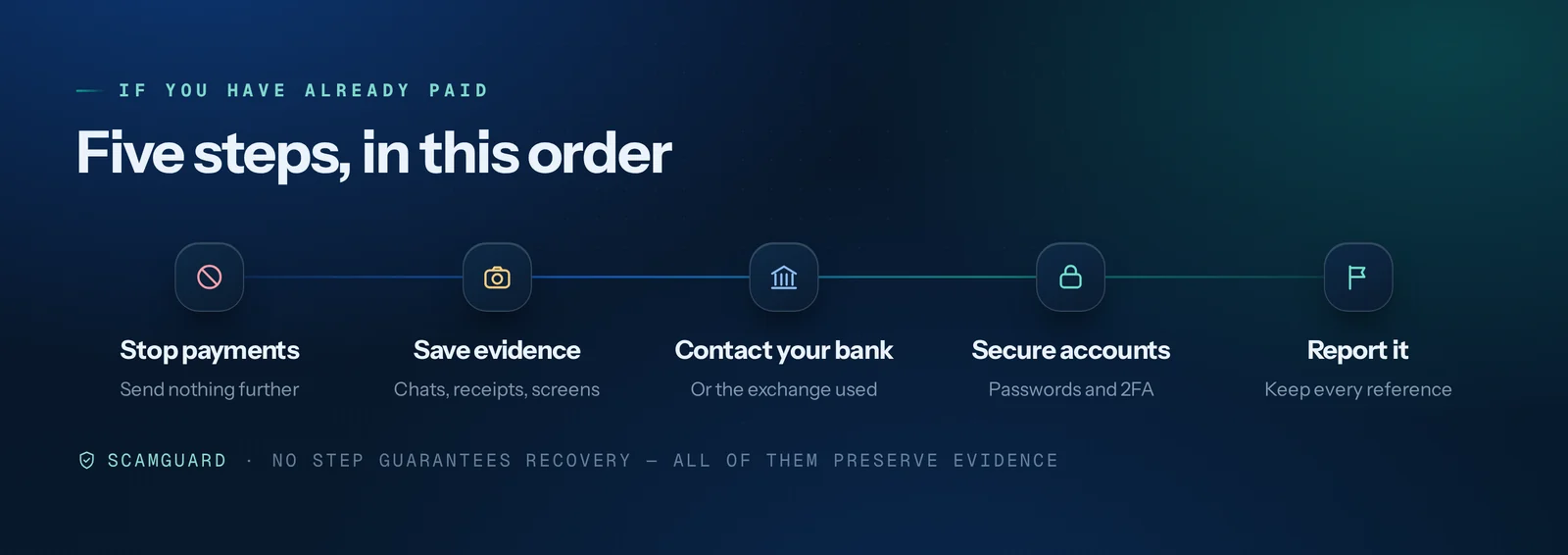
If you have already sent money
Being scammed is not a failure of intelligence; these operations are designed and rehearsed. What matters now is acting quickly and keeping a clear record.
1. Stop all further payments
Do not send a "release fee", "tax" or top-up, even if you are told your balance is about to be lost. Additional payments are part of the script.
2. Preserve the evidence
Save copies outside the platform — it can disappear or lock you out at any time.
3. Contact your payment provider immediately
Call your bank, card issuer or exchange and tell them plainly that you believe you have been defrauded. Ask about recall, chargeback or freezing options. Speed matters: options narrow quickly as funds move.
4. Secure your accounts
Change passwords for your email, banking and exchange accounts, enable two-factor authentication, and remove any remote-access software you were asked to install. If you shared identity documents, watch for impersonation attempts.
5. Report it
Report to your national fraud or police reporting service and your financial regulator, and document the incident on ScamGuard so the platform's details are searchable by others.
How ScamGuard can help
ScamGuard is a reporting and documentation platform. We help you:
- Search existing scam information by name, website, wallet address or phone number
- Document what happened in a structured, private case record with your evidence in one place
- Report the incident so the details become part of a searchable public record for others
To be clear about the limits: ScamGuard does not recover funds, does not act as a law-enforcement or regulatory body, and cannot guarantee any outcome. What we can do is help you organise your evidence, understand the practical next steps, and warn other people about the same operation.
Report the platform and help protect someone else
Documenting what happened takes a few minutes and creates an organised record you can share with your bank, your regulator or the police.
Frequently asked questions
Can a scam investment platform look completely professional?
Yes. Polished design, live charts, mobile apps, verification steps and responsive support are all cheap to produce and are commonly used to build confidence. Appearance is not evidence.
I withdrew money successfully once. Does that mean it is genuine?
Not necessarily. Small early withdrawals are a known tactic used to build trust before a larger deposit is requested. Judge a platform on whether you can withdraw your full balance without new fees or conditions.
Is it worth reporting if I did not lose money?
Yes. Reports about attempts, suspicious domains and contact methods help other people recognise the same approach before they pay. You can report a suspicious platform even if no money changed hands.
Can I stay anonymous when I report?
Your report contributes to public scam information, but personal details are not published alongside it. Read the privacy policy for how your information is handled.
What should I do first if I paid by bank transfer or crypto?
Contact your bank or the exchange immediately and report the transaction as fraudulent, then preserve every record. Reversal is not guaranteed with either method, but acting within hours gives you the best chance.
Where can I check whether a platform has been reported before?
Use ScamGuard search to look up a website, company name, wallet address or phone number, and browse community reports for similar cases.
Stay alert: legitimate organisations will never ask you for your password, private key, seed phrase or a one-time passcode. If something feels off, stop, verify independently, and avoid sending further funds.
Scam alerts
Stay ahead of new scam tactics
Get practical fraud warnings, new ScamGuard Pro investigations and safety guides delivered to your inbox.
No spam. Unsubscribe anytime.