How to Report an Online Scam in the USA: Who to Contact and What Evidence You Need
If you have been scammed online in the United States, knowing what to do next can feel confusing.
Should you contact your bank?
The police?
The Federal Trade Commission?
The FBI?
A cryptocurrency exchange?
The answer depends on what happened and how the money was transferred.
One of the most important things you can do is act quickly, preserve your evidence and make accurate reports through the appropriate channels.
Reporting fraud does not guarantee that lost money will be recovered.
However, reports can create an official record of what happened and provide relevant organisations with information that may assist their work.
This guide explains the major steps U.S. victims can consider after discovering an online scam.
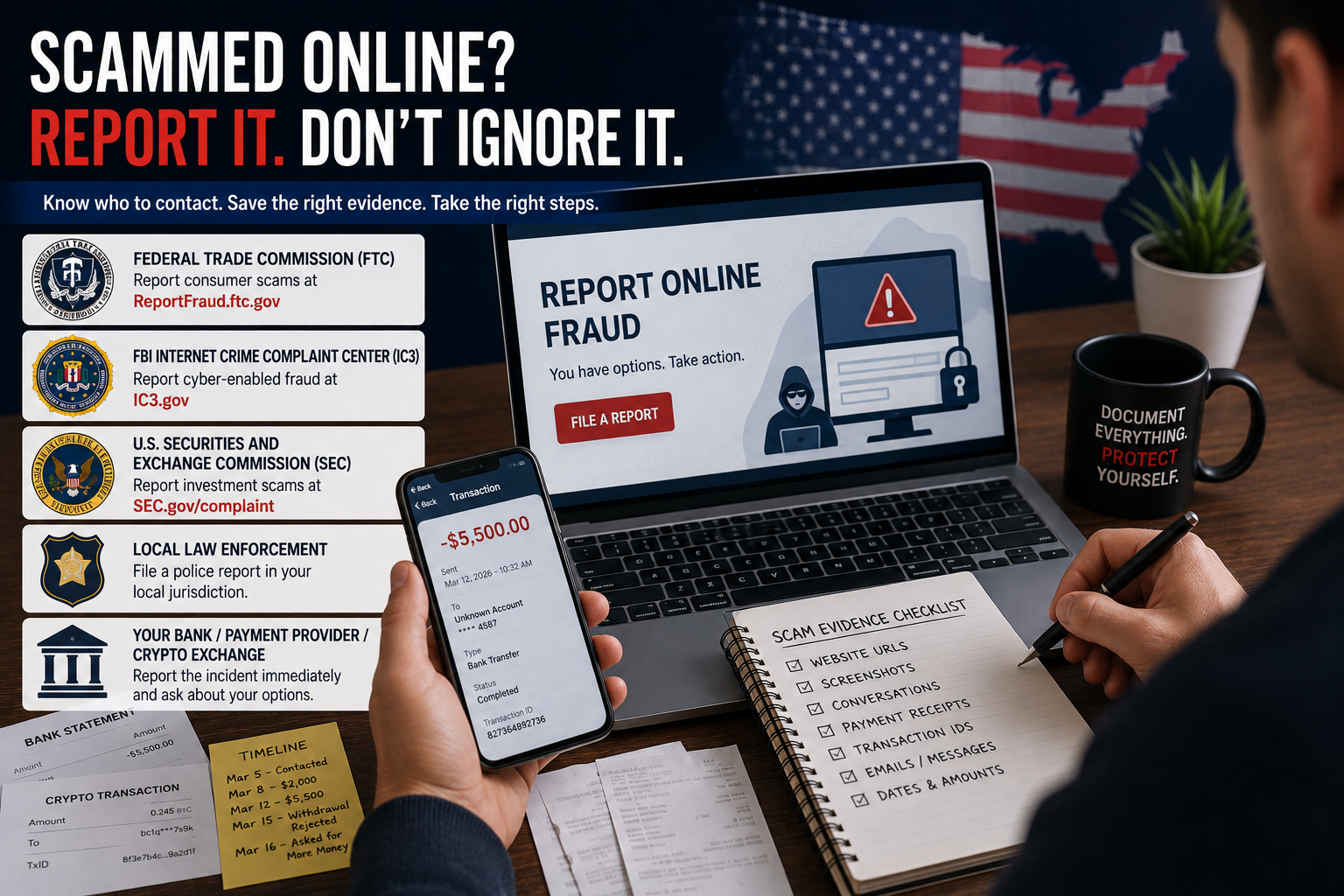
First: Stop Sending More Money
If you suspect that you have been scammed, stop making additional payments while you investigate.
Scammers may claim that one final payment is necessary to:
• release your money • pay a tax • verify your identity • activate a withdrawal • remove an account restriction • pay cryptocurrency gas fees • complete an investigation • recover previously stolen funds
Do not assume that another payment will solve the problem.
Repeated demands for additional money can simply increase the loss.
What Evidence Should You Collect Before Reporting a Scam?
Before filing reports, organise as much information as you reasonably can.
Do not delete conversations or accounts before preserving the evidence.
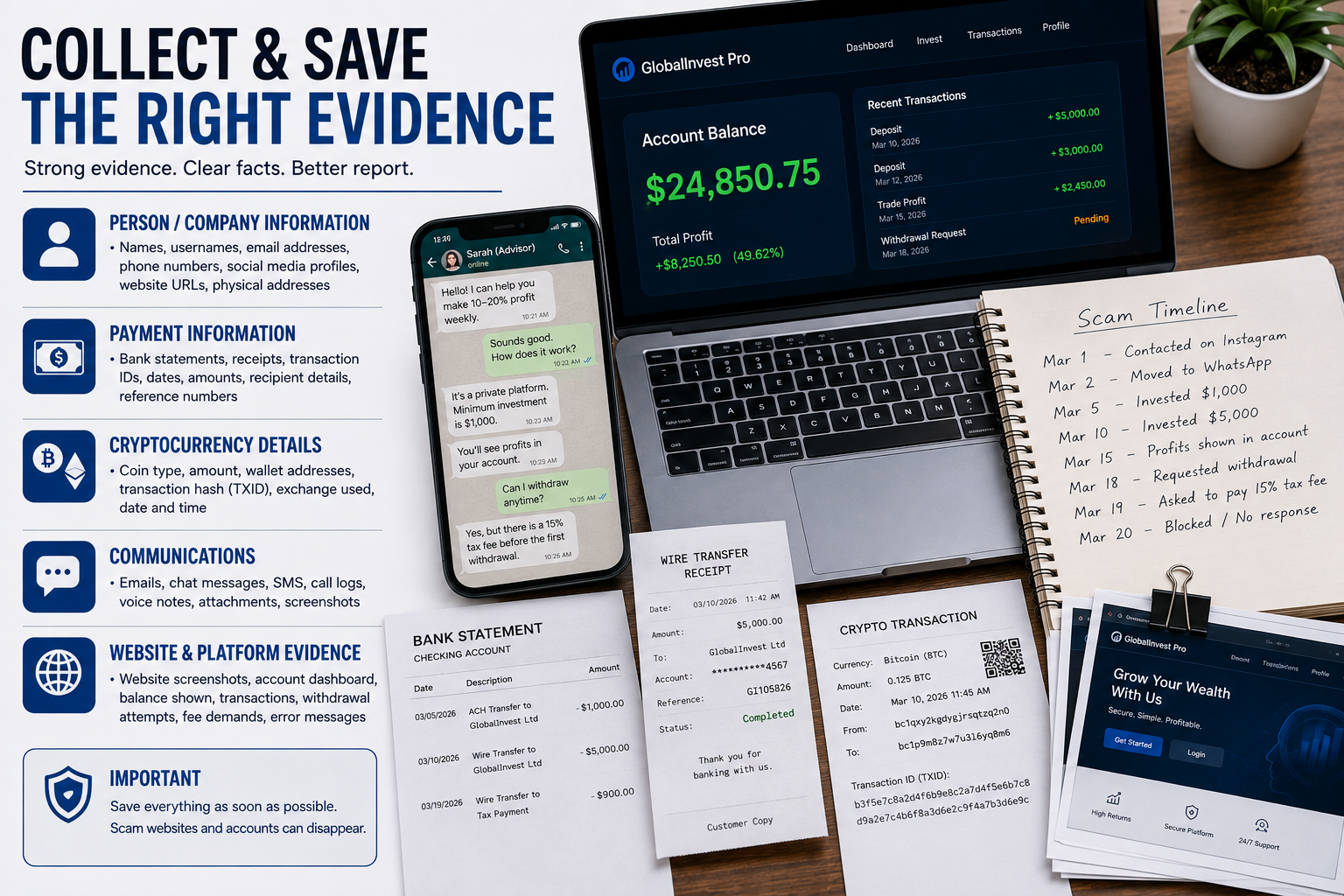
Save the following where applicable.
Information About the Person or Company
Record:
• names used • company names • usernames • profile names • email addresses • telephone numbers • social-media profiles • website addresses • physical addresses they provided
Payment Information
Keep:
• bank statements • transfer receipts • card transactions • payment confirmations • dates • amounts • recipient account information • payment-reference numbers
Cryptocurrency Information
If cryptocurrency was involved, preserve:
• cryptocurrency type • amount • transaction hash or transaction ID • sending wallet address • receiving wallet address • exchange used • date and time • screenshots
Communications
Preserve relevant:
• emails • WhatsApp conversations • Telegram conversations • text messages • social-media messages • dating-app conversations • customer-support chats • voice messages where available
Website Evidence
If a website was involved, save:
• complete website address • screenshots • account dashboard • displayed balance • transaction history • withdrawal attempts • error messages • fee demands • company information displayed on the site
Do this as early as possible.
A fraudulent website or social-media account can disappear.
Create a Simple Scam Timeline
A timeline can make a complicated case much easier to understand.
For example:
March 2 — Contacted through Instagram
March 5 — Moved conversation to WhatsApp
March 8 — Sent $2,000
March 15 — Sent another $5,000
March 27 — Requested withdrawal
March 28 — Withdrawal rejected
March 28 — Asked to pay $3,500 “tax”
April 1 — Realised the platform might be fraudulent
Keep the timeline factual.
Avoid guessing about events you cannot verify.
Contact Your Bank Quickly If You Sent a Bank Transfer
If money was sent through a bank, contact the bank's fraud department promptly.
Explain exactly what happened.
Provide relevant:
• transaction dates • amounts • recipient details • account numbers • communications • website information • receipts
Ask what fraud procedures or possible recovery mechanisms may apply to the transactions.
Be accurate about whether you personally authorised the payment.
If you authorised a transfer because you were deceived, explain that accurately rather than claiming that the transaction itself was unauthorised.
What If You Paid With a Debit or Credit Card?
Contact your card issuer promptly.
Explain that the transactions were connected with a situation you now believe may have involved fraud.
Ask what dispute or fraud procedures are available for those specific transactions.
Provide supporting evidence when requested.
Different circumstances can have different dispute rights, requirements and deadlines.
What If You Paid Through a Payment App?
If you used a payment application or money-transfer service, report the transaction through the provider's official fraud or support process.
Keep the transaction reference number.
Avoid contacting telephone numbers provided to you by the suspected scammer.
Locate the provider's genuine support information independently.
What If You Sent Cryptocurrency?
Cryptocurrency cases require particularly careful record keeping.
Preserve the transaction hash.
Do not rely only on screenshots.
The transaction hash can help identify the blockchain transaction associated with the transfer.
Also record:
• sending address • receiving address • cryptocurrency • amount • date • exchange involved • conversations • screenshots
If you used a legitimate cryptocurrency exchange, contact its official fraud, compliance or customer-support channel as quickly as possible.
Explain what happened accurately and provide the relevant transaction information.
Can Cryptocurrency Transactions Be Traced?
Many public blockchain transactions can be analysed.
It may be possible to observe cryptocurrency moving between addresses.
But this distinction is extremely important:
Tracing cryptocurrency is not the same as recovering cryptocurrency.
Identifying where funds moved does not automatically provide the ability to return them.
Actual recovery can depend on many factors, including where the assets moved, whether identifiable services were involved and whether appropriate legal or institutional processes are available.
Be cautious of anyone claiming that a blockchain diagram alone proves they can recover your money.
Report the Scam to the Federal Trade Commission
For many consumer scams and fraudulent business practices in the United States, victims can submit a report to the Federal Trade Commission through its official fraud-reporting system.
The report can include information such as:
• what happened • how you were contacted • how much money was lost • how payment was made • information about the person or company involved
After submitting a report, keep the report number and related information for your records.
When Should You Report to FBI IC3?
The FBI's Internet Crime Complaint Center, commonly known as IC3, accepts reports involving cyber-enabled crime, including many forms of online fraud and scams.
Examples may include:
• online investment fraud • cryptocurrency scams • business email compromise • phishing • online impersonation • romance-related financial scams • fraudulent websites • account compromise • other cyber-enabled financial fraud
Provide accurate and detailed information.
IC3 states that complaints may be analysed and referred to federal, state, local or international law-enforcement or partner agencies.
Submitting a complaint does not guarantee that an individual investigation will be opened or that money will be recovered.
Important: Preserve Your IC3 Information
Keep records of what you submit.
Save relevant confirmation or submission information.
Continue preserving your original evidence separately.
Do not delete your transaction records or conversations simply because a report has been filed.
What About Investment Scams?
If the incident involves an investment, securities offering, investment account, financial professional or suspected securities fraud, an SEC reporting or complaint channel may also be relevant depending on the circumstances.
Investment scams can include situations involving:
• fraudulent investment opportunities • Ponzi-style schemes • misleading investment claims • unregistered offerings • theft or misuse of investment funds • questionable financial professionals
Use the SEC's official website rather than links sent by people involved in the suspected investment.
Should You Contact Local Police?
Depending on the circumstances, you may also consider reporting the incident to local law enforcement.
A police report can create an additional official record of the incident.
Bring organised evidence where possible.
That may include:
• identification • payment records • transaction history • screenshots • communications • scammer contact details • website information • cryptocurrency transaction information • reports already submitted elsewhere
Do not assume that every local police department has the same procedures or resources for online financial fraud.
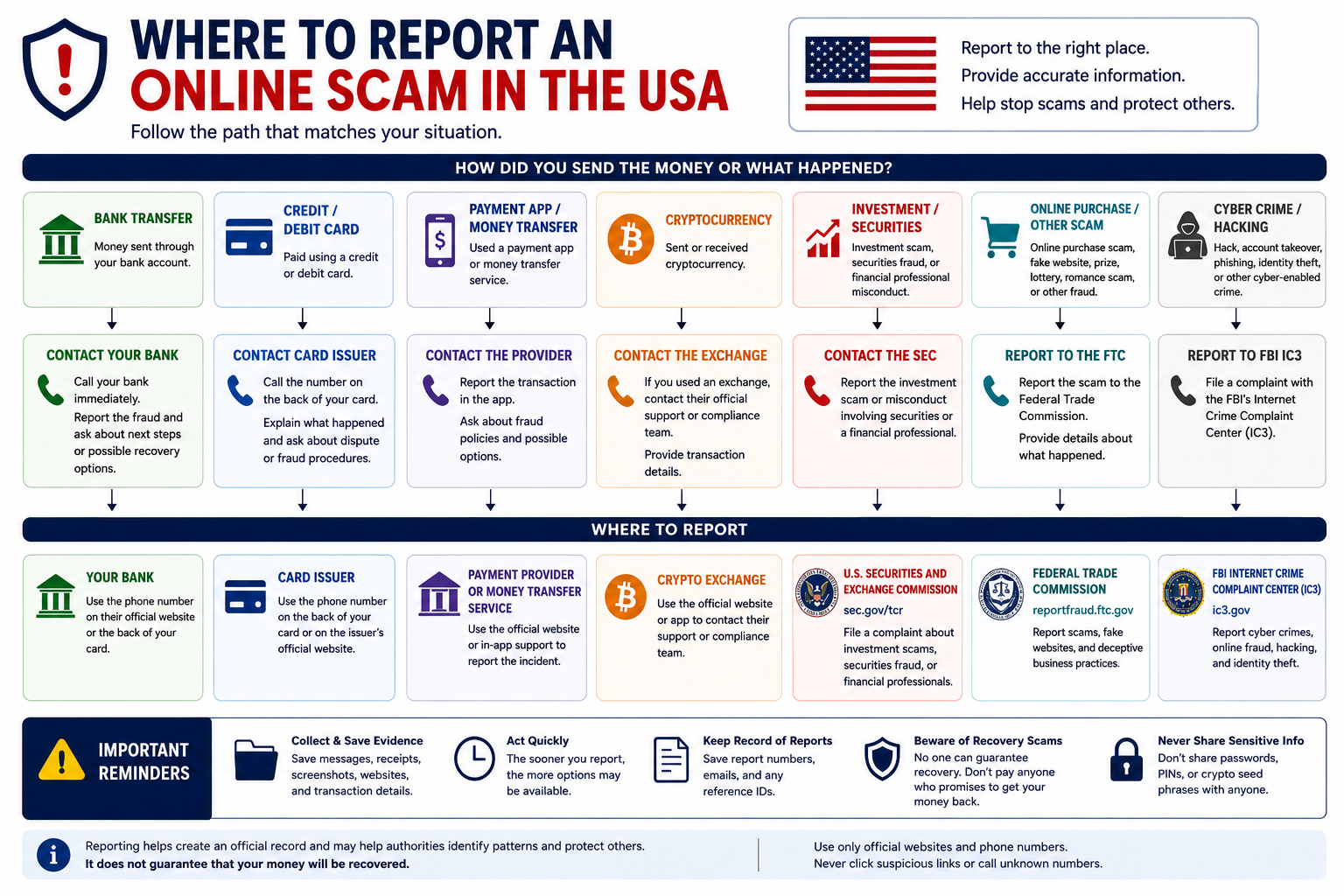
Which Organisation Should I Contact First?
There is not always one correct organisation.
The appropriate route depends on what happened.
A simplified approach may look like this:
BANK TRANSFER → Contact your bank promptly → Preserve evidence → Consider appropriate fraud reports
CREDIT OR DEBIT CARD → Contact the card issuer → Ask about applicable dispute/fraud procedures → Preserve evidence
CRYPTOCURRENCY → Preserve transaction hashes and wallet addresses → Contact the exchange involved where appropriate → Consider IC3 and other relevant reports
ONLINE CONSUMER SCAM → Consider FTC reporting → Contact the payment provider → Preserve evidence
CYBER-ENABLED FRAUD → Consider FBI IC3 → Contact relevant financial institutions
INVESTMENT OR SECURITIES ISSUE → Consider the appropriate SEC complaint/reporting channel → Contact financial institutions involved
Multiple reports may sometimes be appropriate.
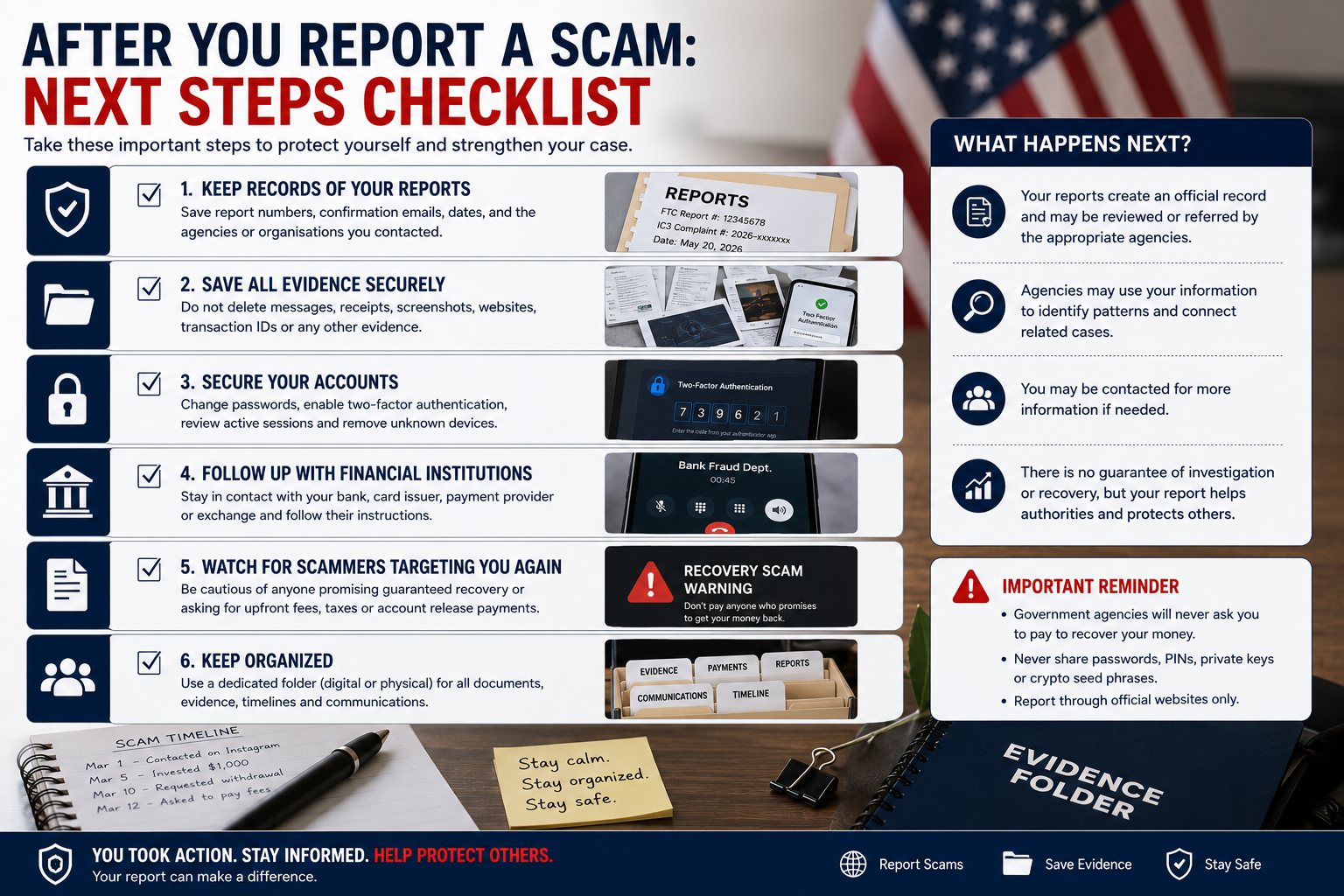
What Happens After You Report a Scam?
Do not expect every report to produce an immediate personal response.
Government agencies receive large numbers of complaints.
A report may contribute information that helps identify patterns, connect related incidents or support future investigations.
Keep:
• report numbers • submission confirmations • dates reported • organisations contacted • names of financial institutions contacted • copies of information submitted
Create a folder specifically for the case.
Do Not Pay Someone Just Because They Claim to Work With the Government
After reporting a scam, you may become a target for another scam.
Someone may contact you claiming:
“We work with the FBI.”
“The government recovered your Bitcoin.”
“Your funds have been frozen.”
“We need a release fee.”
“Pay this tax and your money will be returned.”
Do not automatically believe these claims.
Verify government communications through official channels independently.
FBI IC3 Impersonation Is a Real Risk
Be especially cautious of anyone claiming to be IC3 and offering to recover money.
The FBI's IC3 currently warns that scammers impersonate the organisation.
IC3 says it does not partner with non-law-enforcement entities such as law firms or cryptocurrency services to recover lost funds, and it warns that IC3 will not directly contact victims asking for information or money.
If someone claiming to represent IC3 demands payment, independently verify the communication.
Watch for Recovery Scams
Fraud victims can become attractive targets because scammers know they want their money back.
A supposed recovery specialist may say:
“We traced everything.”
“Your cryptocurrency is sitting in a frozen wallet.”
“We already have your funds.”
“We only need $2,500 for the release.”
Be extremely cautious.
A guarantee of recovery combined with an unexpected upfront payment is a serious warning sign.
Never Provide Your Crypto Seed Phrase
No legitimate reporting process requires you to publish your cryptocurrency wallet seed phrase or private key.
Never include these in:
• government complaint forms • community posts • emails • screenshots • evidence uploads • messages to supposed investigators
Anyone who obtains your seed phrase may be able to control the assets associated with the wallet.
Secure Your Accounts After a Scam
Reporting the fraud is only part of the response.
If sensitive information may have been compromised, secure your accounts.
Consider:
• changing affected passwords • enabling two-factor authentication • reviewing active sessions • removing unknown devices • securing your email account • contacting your bank • securing cryptocurrency exchange accounts • reviewing payment accounts
If you installed remote-access software at someone's request, take additional steps to secure the affected device and accounts.
Do Not Destroy Evidence After Reporting
Keep the evidence even after submitting complaints.
An organisation may request additional information later.
Maintain copies of:
• reports • screenshots • conversations • transaction records • emails • wallet information • bank records • website information
Store them securely.
Organise Your Scam Information in One Place
A scam may involve dozens or even hundreds of pieces of information.
ScamGuard Pro can help you organise information connected with an incident, including:
• websites • people involved • payment information • transaction records • cryptocurrency wallet addresses • communications • supporting evidence
Keeping information organised can make it easier to understand the sequence of events and determine which legitimate reporting or support options may be relevant.
ScamGuard Pro is an independent platform and is not the FBI, FTC, SEC or another government agency.
ScamGuard Pro does not guarantee recovery of lost funds.
Frequently Asked Questions
Where do I report an online scam in the USA?
The appropriate reporting route depends on the incident.
Depending on the circumstances, relevant organisations can include your bank or payment provider, the FTC, FBI IC3, SEC, cryptocurrency exchanges and local law enforcement.
Should I contact my bank before reporting the scam to the government?
If money was transferred through your bank or card provider, contacting the financial institution promptly can be important.
You can also make appropriate government reports.
Can the FBI recover money lost in an online scam?
Submitting an IC3 complaint does not guarantee an investigation or recovery.
Avoid anyone claiming that filing an IC3 complaint guarantees your money will be returned.
Does the FTC investigate every individual scam report?
A report does not mean that every victim will receive an individual investigation.
Reports can help authorities identify fraudulent activity and patterns.
Should I report a cryptocurrency scam to IC3?
IC3 accepts reports involving cyber-enabled fraud and scams, which can include cryptocurrency-related fraud depending on the circumstances.
Preserve transaction hashes, wallet addresses and exchange information.
Can I report a fake investment platform to the SEC?
If the circumstances involve suspected securities fraud, an investment account, financial professional or related investment misconduct, an SEC complaint or reporting channel may be relevant.
What information should I include in a scam report?
Include accurate information such as:
• what happened • when it happened • how you were contacted • how much was transferred • how you paid • recipient information • websites • usernames • email addresses • phone numbers • transaction information
Do not include passwords, seed phrases or private keys.
Should I pay someone who says they can speed up my government complaint?
Be extremely cautious.
Government reporting should be performed through verified official channels.
Do not pay an unknown person simply because they claim to have connections with the FBI, FTC, SEC or another government organisation.
Final Takeaway
If you have been scammed online in the United States, acting quickly and methodically can help you protect yourself and preserve important information.
Remember:
- Stop sending additional money.
- Preserve your evidence.
- Create a timeline.
- Contact the relevant bank, card issuer or payment provider.
- Preserve cryptocurrency transaction information when applicable.
- Submit appropriate official reports.
- Secure compromised accounts.
- Keep copies of everything.
- Be cautious of anyone promising guaranteed recovery.
- Never provide passwords, private keys or seed phrases.
Reporting a scam does not guarantee that lost money will be recovered.
But accurate, organised information gives financial institutions, reporting organisations and other legitimate parties a clearer record of what happened.
Stay alert: legitimate organisations will never ask you for your password, private key, seed phrase or a one-time passcode. If something feels off, stop, verify independently, and avoid sending further funds.
Scam alerts
Stay ahead of new scam tactics
Get practical fraud warnings, new ScamGuard Pro investigations and safety guides delivered to your inbox.
No spam. Unsubscribe anytime.