How to Recover Money From a Fake Investment Platform: What Victims Should Do in 2026
You deposited money into an investment platform.
Your account appeared to grow.
The dashboard showed profits.
Everything seemed normal until you tried to withdraw your money.
Suddenly, the platform demanded a tax, verification payment, withdrawal fee, security deposit or another payment before your funds could supposedly be released.
This is a major warning sign of a fake investment platform.
If you believe you have sent money to a fraudulent investment or trading platform, stop sending additional funds and begin preserving evidence immediately.
Recovering money is not guaranteed. What may be possible depends on how you paid, where the funds went, how quickly you act and the circumstances of your individual case.
This guide explains what to do next.
What Is a Fake Investment Platform?
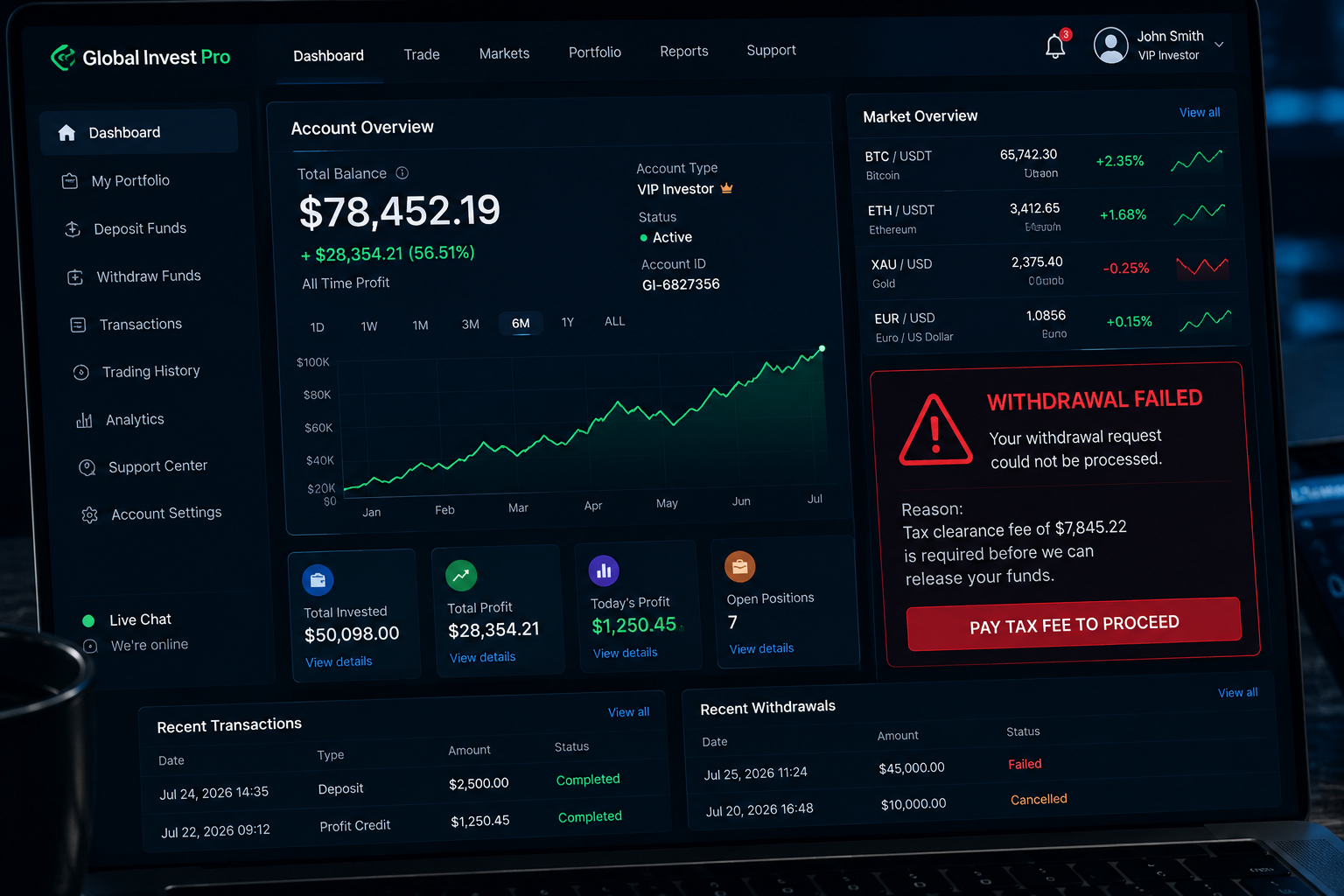
A fake investment platform is a website, application or online service designed to convince victims that their money is being legitimately invested when the displayed account activity may be fabricated.
These platforms can imitate legitimate:
- Cryptocurrency exchanges
- Forex brokers
- Stock trading platforms
- Investment management companies
- Commodity trading services
- Wealth-management platforms
- Automated trading systems
Some are professionally designed.
They may include charts, customer-support representatives, account managers, transaction histories and sophisticated-looking dashboards.
The appearance of a professional website does not prove that the investments shown on it actually exist.
How Fake Investment Platforms Usually Work
The exact approach varies, but many cases follow a similar pattern.
Step 1 — Initial Contact
The victim may first encounter the investment through:
- Social media
- Telegram
- Dating applications
- Investment groups
- Online advertisements
- Unsolicited text messages
- Someone they met online
The person may initially appear helpful rather than aggressive.
Step 2 — A Small Initial Investment
The victim is encouraged to start with a relatively small amount.
After depositing money, the investment dashboard may begin showing profits.
For example:
Deposit: $1,000
Displayed balance several days later: $1,340
The apparent success can encourage the victim to deposit more.
Step 3 — Increasing Deposits
The supposed adviser may then recommend a larger opportunity.
They might say:
“This trade won't happen again.”
“You need to increase your position.”
“You've qualified for our VIP investment level.”
“This is your opportunity to make a much larger return.”
The victim deposits additional funds.
Step 4 — The Dashboard Shows Large Profits
Eventually the account may display substantial gains.
Someone who deposited $20,000 might see a displayed balance of $75,000 or more.
But numbers appearing on a website are not proof that the money exists.
A fraudulent platform can display virtually any account balance its operators choose.
Step 5 — The Victim Attempts a Withdrawal
This is often when the situation changes.
The withdrawal may become:
- Pending
- Rejected
- Frozen
- Under review
- Restricted
Step 6 — Another Payment Is Demanded
The platform then claims money must be paid before the withdrawal can proceed.
Common explanations include:
- Tax
- Withdrawal fee
- Verification fee
- Security deposit
- Account upgrade
- Liquidity fee
- AML verification fee
- Processing fee
- Commission
- Cryptocurrency gas fee
This can be a form of advance-fee fraud.
\\\\## Do Not Pay a “Tax” to Unlock Your Investment Account
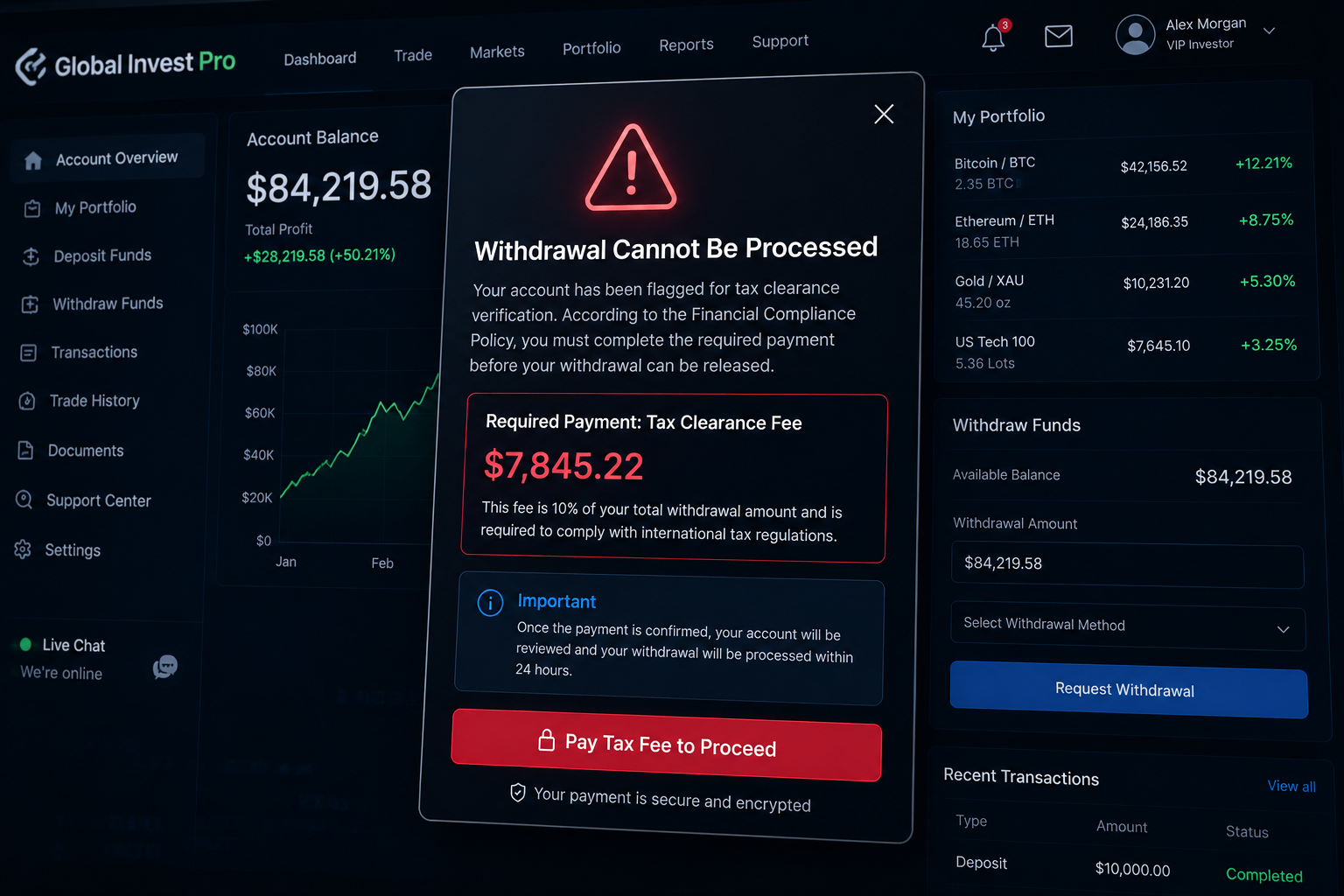
One of the most important things to understand is that another payment does not necessarily unlock the money shown on the dashboard.
If a suspicious platform suddenly tells you:
“Your balance is $84,000, but you must pay $8,400 tax before withdrawing.”
Do not automatically send the payment.
Independently verify the demand first.
Unexpected demands for additional payments before supposedly releasing investment proceeds are a recognised warning sign of advance-fee fraud.
Paying another fee can simply create another loss.
The next demand may then be:
“Your tax was received, but now you need a security deposit.”
Then:
“Your account requires AML verification.”
Then:
“Your withdrawal exceeded the limit and requires an upgrade.”
There may never be a final payment.
Can Money Lost to a Fake Investment Platform Be Recovered?
Sometimes recovery may be possible, but there is no universal recovery method.
The answer depends heavily on the circumstances.
Important factors include:
- How the money was transferred
- When the transactions occurred
- Which financial institutions were involved
- Whether cryptocurrency was used
- Where the funds subsequently moved
- Whether identifiable exchanges received cryptocurrency
- Whether recipient accounts can be identified
- What evidence remains
- Which jurisdiction is involved
- Whether legal or institutional intervention is available
Anyone claiming to know with certainty that your money can be recovered before examining these details should be treated cautiously.
Step 1: Stop Sending Additional Money
Do not attempt to “complete” the withdrawal by repeatedly paying new fees.
Stop additional payments while you investigate.
Do not allow pressure such as:
“Pay within 24 hours.”
“Your account will be permanently frozen.”
“Your profits will disappear tonight.”
“Your account will be reported for money laundering.”
to force you into another transfer.
Urgency can be used to prevent victims from independently verifying what is happening.
Step 2: Do Not Delete the Investment Account Yet
Your first instinct may be to delete everything.
Preserve evidence first.
Take screenshots of:
- Your account dashboard
- Displayed balance
- Transaction history
- Deposit history
- Withdrawal history
- Withdrawal rejection
- Error messages
- Fee demands
- Account-manager profile
- Customer-support conversations
Also record the complete website address.
Do this while the platform remains accessible.
Fraudulent websites can disappear.
Step 3: Preserve Every Conversation
Keep your communications with everyone connected to the investment.
This may include:
- WhatsApp messages
- Telegram chats
- Text messages
- Emails
- Instagram messages
- Facebook messages
- Dating-app conversations
- Investment group messages
- Customer-support chats
Preserve usernames and profile information too.
Do not save only the final messages.
Earlier conversations may show how the investment was introduced and what representations were made.
Step 4: Record Every Transaction
Create a chronological record.
For example:
January 8 — $2,000 initial investment
January 16 — $5,000 additional deposit
January 27 — $10,000 investment
February 3 — Withdrawal requested
February 4 — Withdrawal rejected
February 4 — Platform requested $6,500 “tax”
This makes the case much easier to understand.
If You Paid by Bank Transfer
Contact your bank or financial institution as quickly as possible.
Tell its fraud department accurately what happened.
Provide:
- Transaction dates
- Amounts
- Recipient information
- Bank account details
- Communications
- Website information
- Evidence showing how the investment was represented
Ask what fraud procedures or possible transaction-recovery mechanisms may apply.
Do not falsely describe a transaction as unauthorised if you personally authorised it.
Explain accurately that you authorised the payment because of the alleged fraudulent investment circumstances.
If You Paid by Debit or Credit Card
Contact the card issuer.
Explain that the payment was connected with an investment platform you now believe may have been fraudulent.
Ask what dispute or fraud procedures may be available for the specific transactions.
Timing can matter, so contacting the provider promptly is important.
If You Paid With Cryptocurrency
Cryptocurrency cases require additional evidence.
Record:
- Cryptocurrency type
- Amount transferred
- Date and time
- Transaction hash / transaction ID
- Sending wallet
- Receiving wallet
- Exchange used to purchase cryptocurrency
- Exchange used to withdraw cryptocurrency
- Screenshots
- Conversations
Do not simply record the person's cryptocurrency username.
The blockchain transaction information can be particularly important.
\\\\## Can Cryptocurrency From an Investment Scam Be Traced?
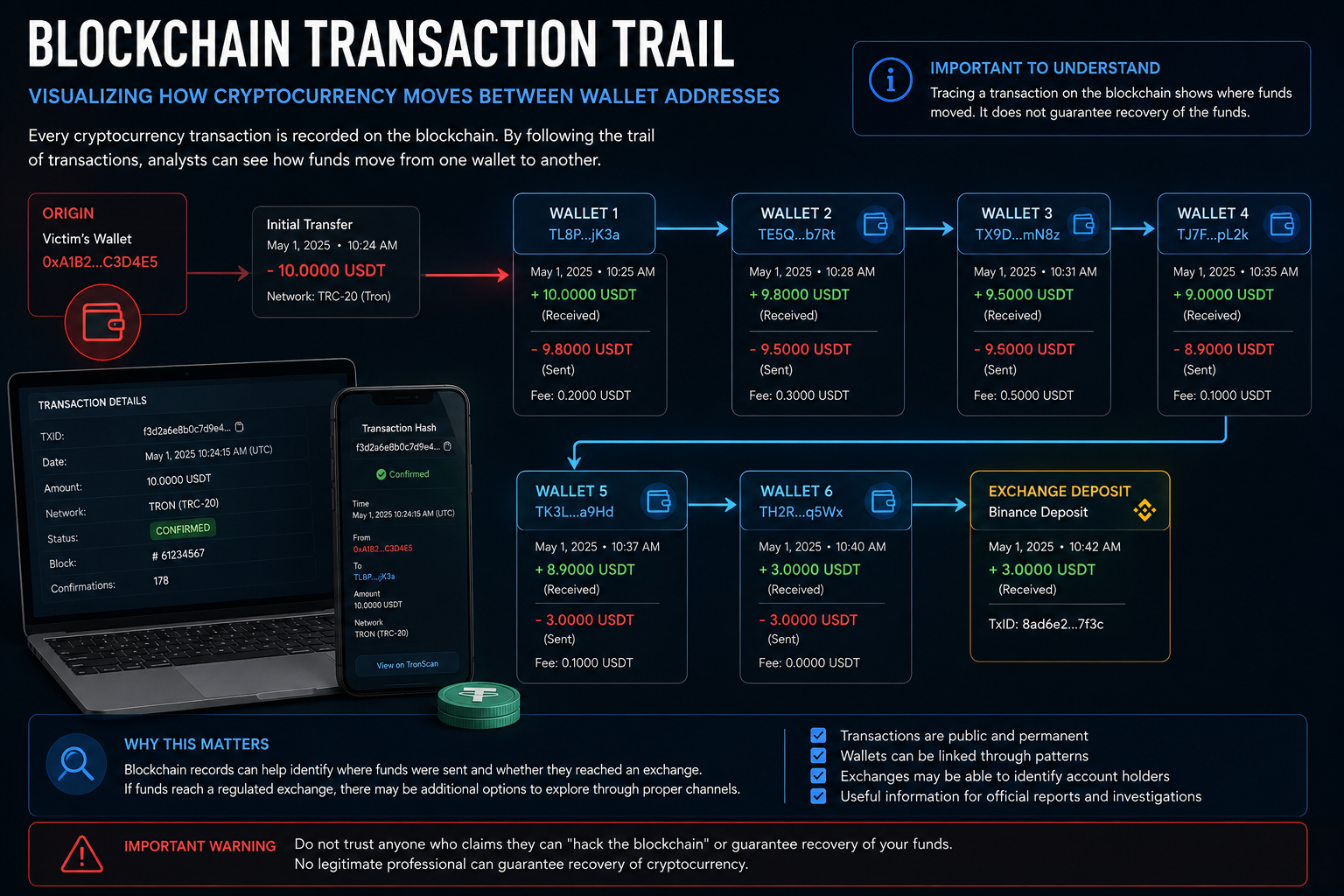
Blockchain transactions on many public networks can be observed and analysed.
Transaction records may show cryptocurrency moving from one address to another.
Tracing Funds Does Not Automatically Mean Recovering Funds
A blockchain analysis might identify where assets moved.
Actual recovery can depend on whether assets reach identifiable services, whether those services can act, applicable legal processes and numerous other circumstances.
Be suspicious of anyone who shows you a blockchain diagram and claims that this alone proves they can return your cryptocurrency.
Contact Cryptocurrency Exchanges Quickly
If cryptocurrency was purchased or transferred through a legitimate exchange, contact the exchange's fraud, compliance or support team.
Provide accurate transaction information.
If you know that funds were transferred to an address associated with a particular service, include that information in reports to appropriate organisations.
Do not impersonate law enforcement or send fabricated legal requests.
Step 5: Secure Your Accounts
If the fake investment platform or its representatives obtained sensitive information, secure your accounts.
Change passwords for:
- Banking
- Cryptocurrency exchanges
- Social media
- Apple/Google accounts
- Payment services
Enable two-factor authentication where available.
Review active login sessions.
Remove devices you do not recognise.
If someone persuaded you to install remote-access software, disconnect and secure the affected device.
Never Give Anyone Your Seed Phrase or Private Key
This deserves special attention.
A cryptocurrency recovery process should not require you to hand over your wallet's seed phrase or private key.
Anyone possessing your seed phrase or private key may be able to control the assets in that wallet.
Never post these details publicly.
Never upload them as evidence.
Never provide them in a community comment.
Never send them to someone who contacts you promising recovery.
Step 6: Report the Investment Scam
Depending on your location and circumstances, appropriate reporting channels may include:
- Your bank
- Your card issuer
- Cryptocurrency exchanges
- Financial regulators
- Consumer-protection organisations
- Law enforcement
- Platforms where the scammer contacted you
Keep any complaint or reference numbers you receive.
What U.S. Victims Can Do
Victims in the United States may consider reporting suspected investment fraud through appropriate official channels, including the Federal Trade Commission, SEC and FBI Internet Crime Complaint Center depending on the circumstances.
Do not assume that submitting a report guarantees an investigation or recovery.
Keep copies of everything you submit.
Beware of “Recovery Agents” Who Contact You Afterwards
The danger may not end when the original investment scam ends.
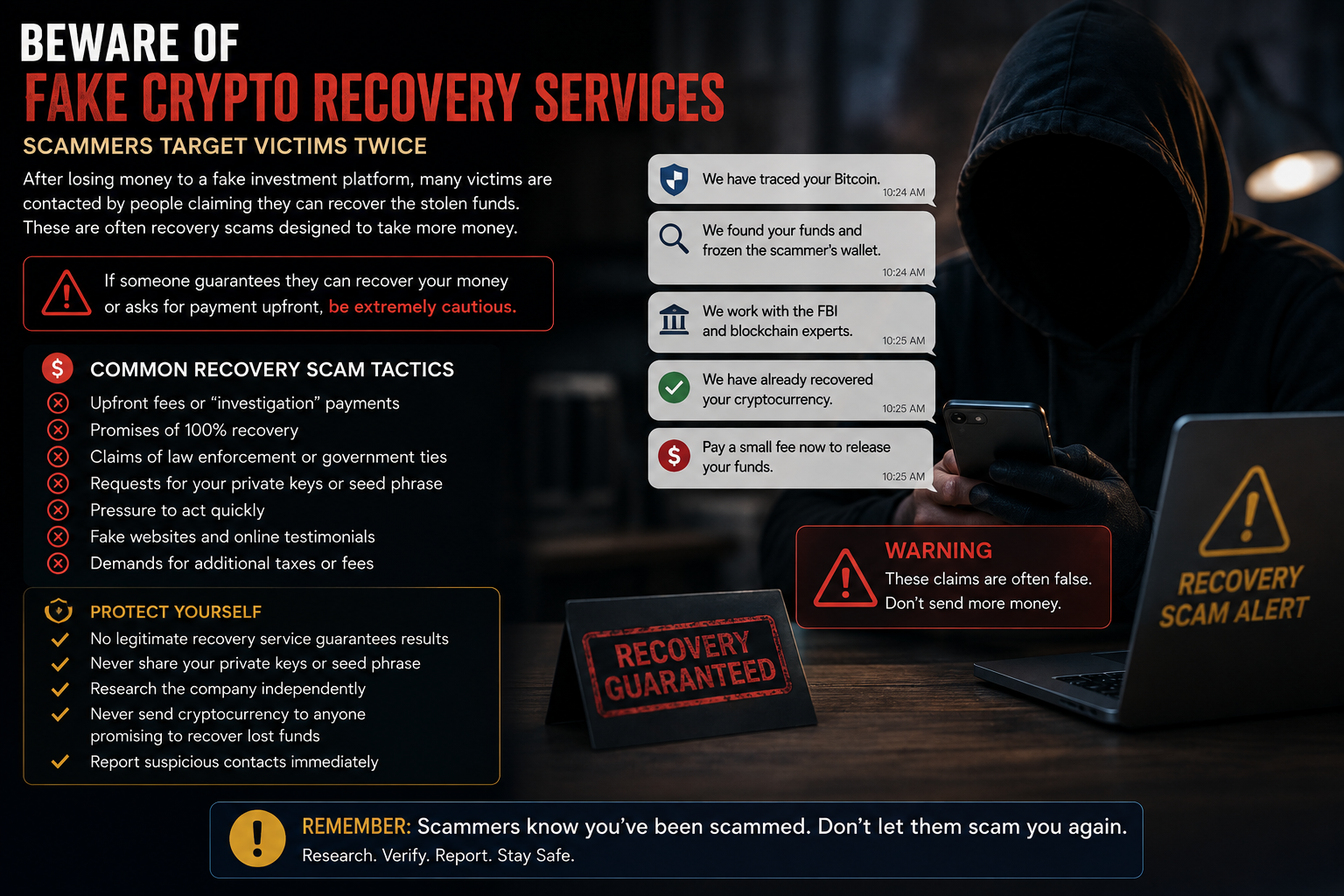
People who have already lost money can become targets of another scheme.
Someone may contact you saying:
“We traced your stolen Bitcoin.”
“We found your funds.”
“We have frozen the scammer's wallet.”
“We work with the FBI.”
“We have already recovered your cryptocurrency.”
They then ask for money.
This should be treated with extreme caution.
\\\\## Common Recovery-Scam Fees
A supposed recovery service may request:
- Upfront investigation fees
- Release fees
- Cryptocurrency gas fees
- Taxes
- Wallet activation fees
- Legal processing fees
- Anti-money-laundering charges
An unexpected demand for money combined with a guarantee of recovery is a serious warning sign.
Questions to Ask Before Trusting Anyone Offering Recovery Help
Ask:
- Who exactly operates the organisation?
- Can its identity be independently verified?
- What exactly will it do?
- Is it promising an outcome it cannot guarantee?
- Is it asking for cryptocurrency before explaining the process?
- Does it claim affiliation with law enforcement?
- Can that claimed affiliation be independently verified?
- Does it require your seed phrase or private key?
- Is it creating artificial urgency?
Do not rely only on testimonials displayed on the organisation's own website.
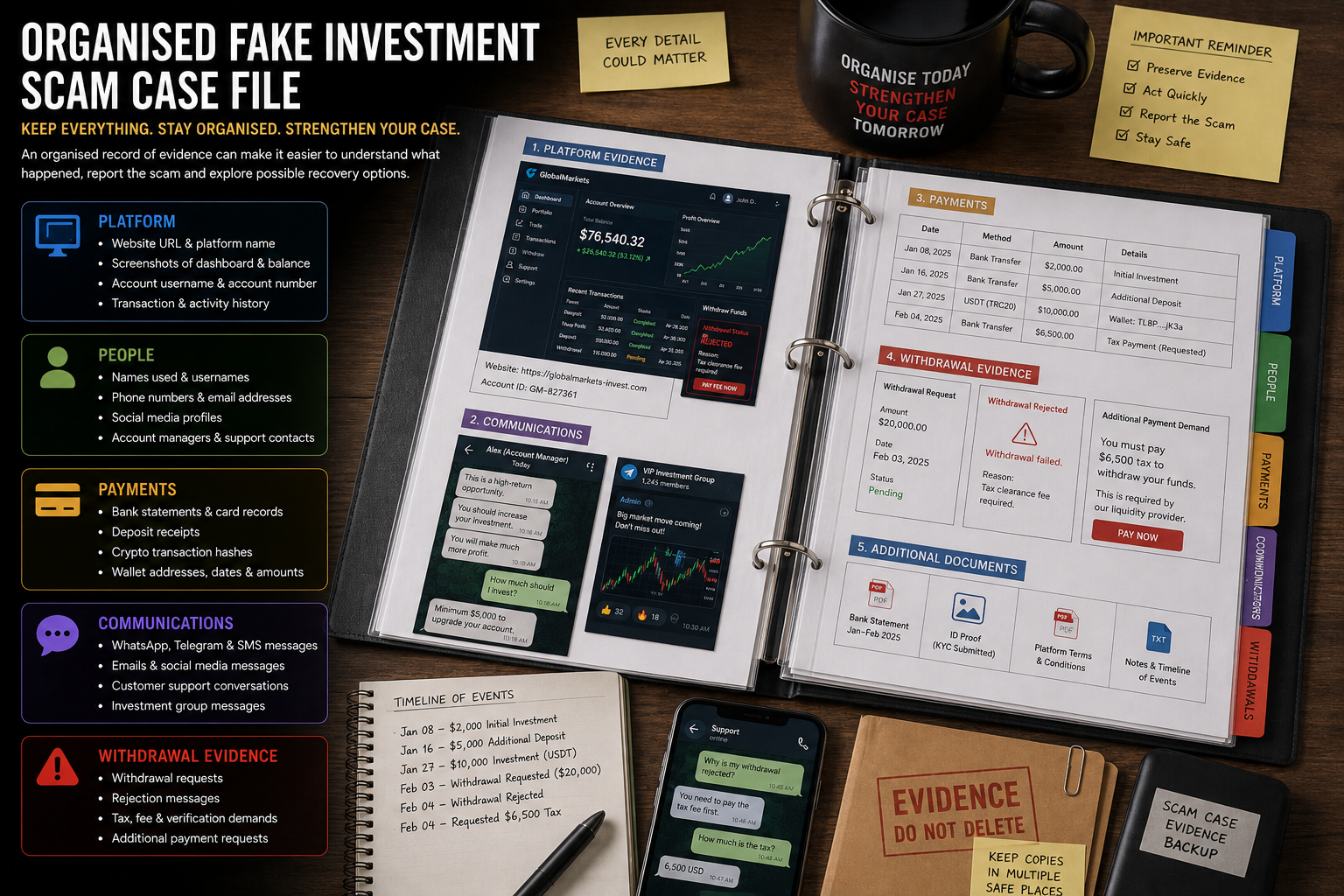
Evidence Checklist for Fake Investment Platform Victims
Before seeking further assistance, organise the following.
Platform
- Website URL
- Platform name
- Screenshots
- Account username
- Account number
- Displayed balance
- Transaction history
People
- Names used
- Usernames
- Phone numbers
- Email addresses
- Social-media profiles
Payments
- Bank records
- Card records
- Receipts
- Cryptocurrency transaction hashes
- Wallet addresses
- Dates
- Amounts
Communications
- Telegram
- SMS
- Social media
- Customer-support messages
Withdrawal Evidence
- Withdrawal request
- Rejection message
- Tax demand
- Verification demand
- Additional fee requests
\\\\## How ScamGuard Pro Can Help You Organise Your Case
If you believe you have been affected by a fake investment platform, ScamGuard Pro can help you organise the information connected with the incident.
You can document:
- The platform involved
- Websites
- People who contacted you
- Payment information
- Cryptocurrency transactions
- Communications
- Supporting evidence
Your case information can then be reviewed to help identify possible next steps based on the circumstances.
ScamGuard Pro does not guarantee that lost funds can be recovered.
Recovery possibilities depend on the individual case.
\\\\## Frequently Asked Questions
Is a Platform Definitely Fake If It Won't Let Me Withdraw?
Not necessarily. Legitimate financial services can restrict accounts for valid reasons.
However, repeated demands to send additional money before you can withdraw should be investigated carefully.
Should I Pay Tax Directly to an Investment Platform Before Withdrawing?
Be cautious of unexpected tax demands, particularly where the platform insists that additional funds must be deposited before existing funds can be released.
Independently verify any claimed tax obligation.
Can My Bank Reverse an Investment Scam Payment?
Possibly in some circumstances. The available options depend on the payment type, timing, bank procedures and facts of the transaction.
Contact your bank promptly.
Can Bitcoin or USDT Sent to a Fake Investment Platform Be Recovered?
Sometimes there may be investigative, exchange, legal or other routes worth exploring, but cryptocurrency recovery is not guaranteed.
Preserve the transaction hash, wallet addresses and exchange records.
The Platform Says My Withdrawal Is Frozen. Should I Send More Money?
Do not automatically send additional money.
Unexpected demands for taxes, deposits or fees to unlock supposed investment proceeds are a known scam warning sign.
Someone Says They Already Recovered My Stolen Cryptocurrency. Is That Possible?
Treat unsolicited claims like this with significant caution.
Verify the person's identity and claims independently before providing personal information or sending money.
How Quickly Should I Act After Discovering an Investment Scam?
As quickly as reasonably possible.
Preserve evidence and contact relevant financial institutions, exchanges and reporting organisations.
Do not delay because someone on the platform promises that another payment will solve the problem.
Final Takeaway
A professional-looking trading dashboard does not prove that an investment is legitimate.
Displayed profits do not prove the money exists.
And a demand for another payment does not prove that a withdrawal will be released.
If you believe you have encountered a fake investment platform:
- Stop sending money.
- Preserve the website and account evidence.
- Save every conversation.
- Record every transaction.
- Contact relevant banks or exchanges.
- Secure your accounts.
- Report the suspected fraud through appropriate channels.
- Be extremely cautious of guaranteed recovery offers.
The earlier you organise the evidence, the easier it becomes to understand what happened and explore the legitimate options available.
Stay alert: legitimate organisations will never ask you for your password, private key, seed phrase or a one-time passcode. If something feels off, stop, verify independently, and avoid sending further funds.