How to Check If an Investment Website Is Legit or a Scam Before Sending Money
Finding a professional-looking investment website does not mean you have found a legitimate investment company.
Fake trading and investment platforms can have polished websites, live-looking charts, customer-support teams, account managers and dashboards showing impressive profits.
Before sending money, take time to independently verify the platform.
This guide explains some of the most important checks you can perform.
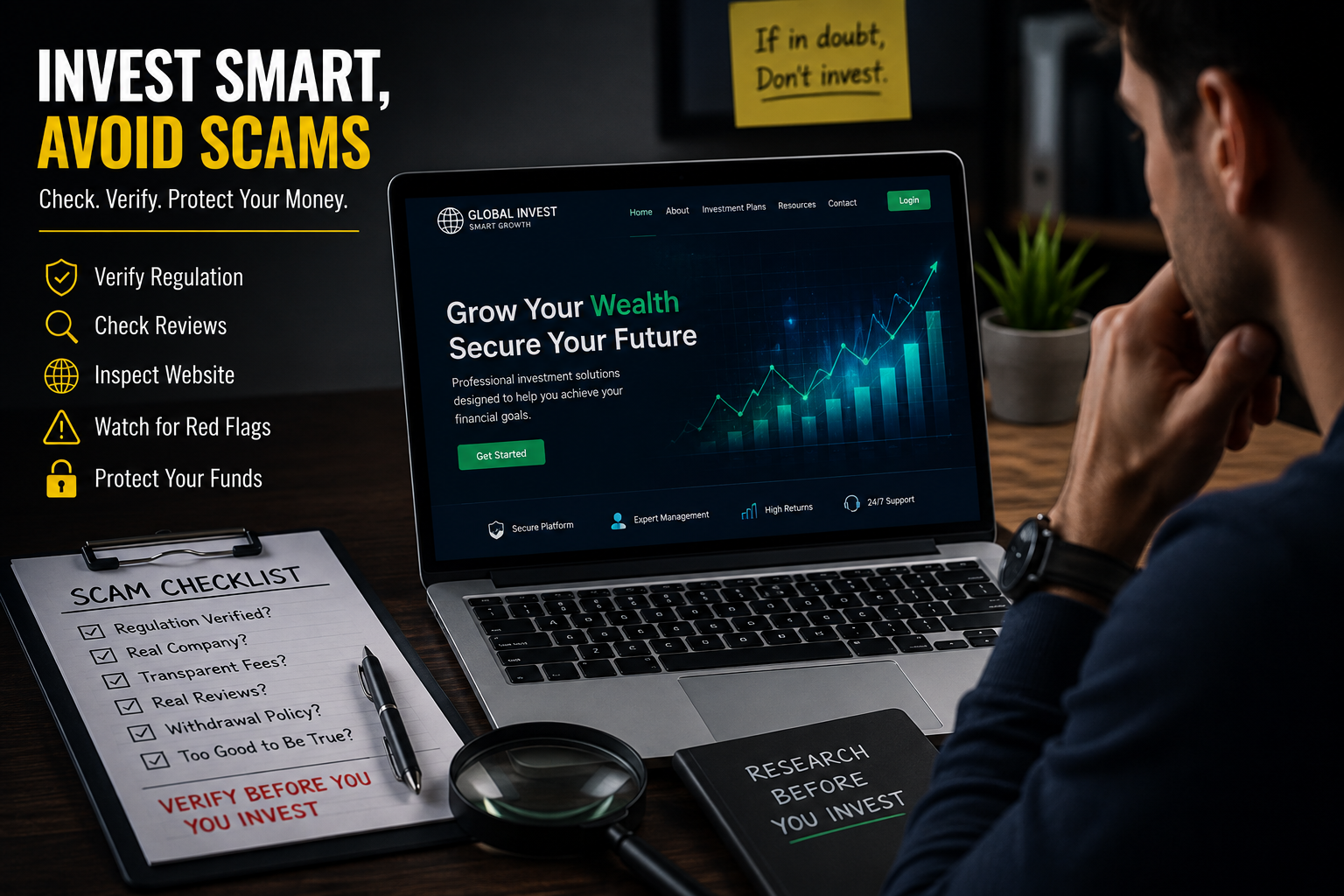
1\. Check Who Actually Operates the Website
Start with a basic question:
Who owns and operates this investment platform?
Look for:
• the legal company name • registration information • physical business address • telephone number • regulatory information • terms and conditions • privacy policy
Do not assume these details are genuine simply because they appear on the website.
Verify important information independently.
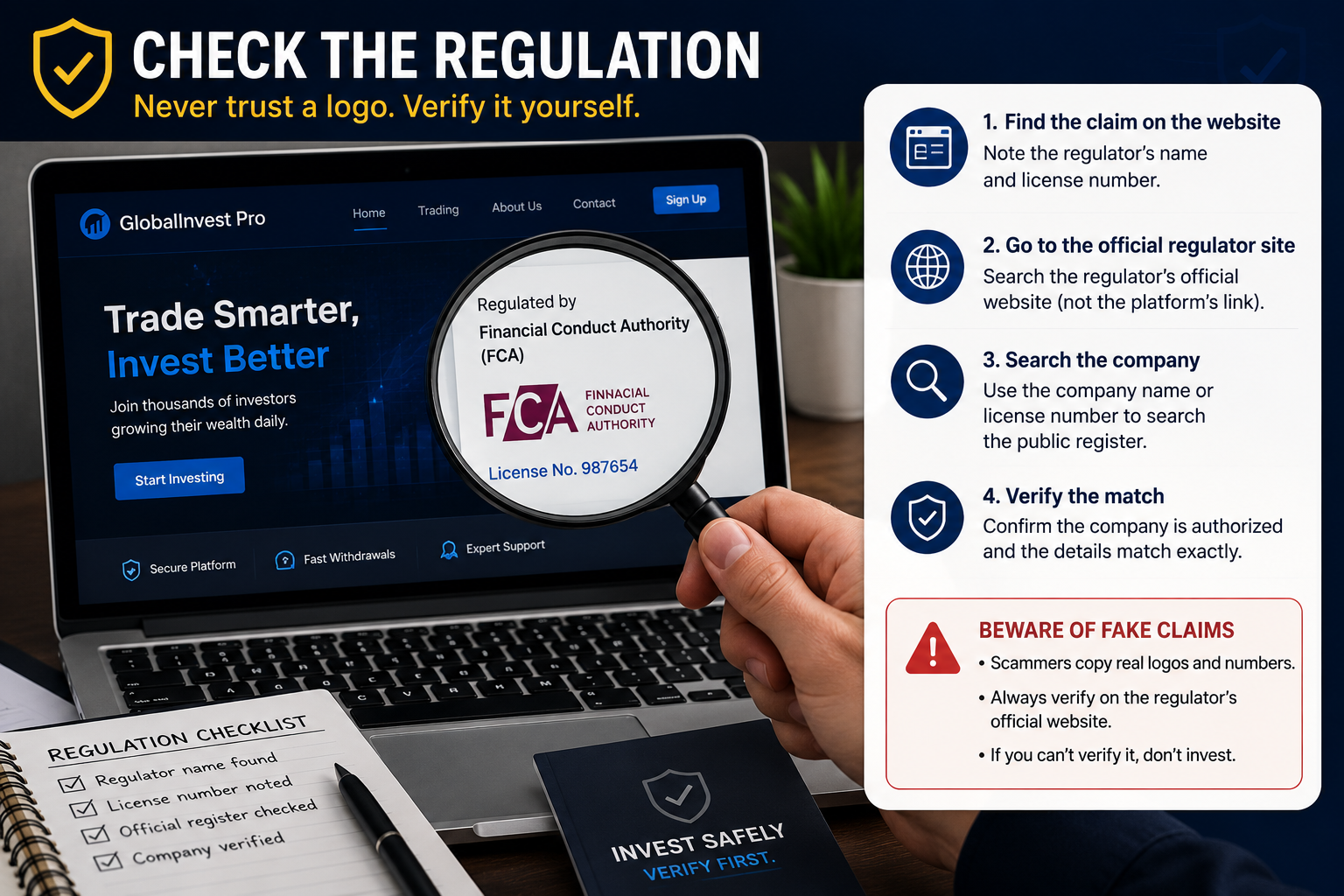
2\. Check Whether the Company Is Actually Regulated
If a platform claims to be regulated, independently check that claim with the regulator it names.
Do not rely on a regulatory badge or licence number displayed on the investment website itself.
Fraudulent websites can copy:
• company names • licence numbers • regulatory logos • addresses • employee identities
This can make an unrelated fraudulent website appear connected to a legitimate company.
3\. Check the Exact Website Domain
Pay close attention to the domain name.
A fraudulent website may use a domain that looks very similar to a legitimate company's website.
For example, scammers may:
• add an extra word • change one letter • add a hyphen • use a different domain extension • imitate the branding of another company
Always verify the exact domain independently.
4\. Investigate How You Found the Platform
Think about how the investment opportunity reached you.
Be particularly cautious when an investment begins through:
• an unsolicited WhatsApp message • Telegram • Instagram • Facebook • a dating application • an investment group • an unexpected text message • a stranger contacting you online
The method of contact alone does not prove fraud, but it can provide important context.
5\. Be Suspicious of Guaranteed Returns
Investments involve risk.
Claims such as:
“Guaranteed 10% every week”
“Zero risk”
“Guaranteed daily profit”
“You cannot lose”
should receive serious scrutiny.
A legitimate-looking dashboard does not make unrealistic promises credible.
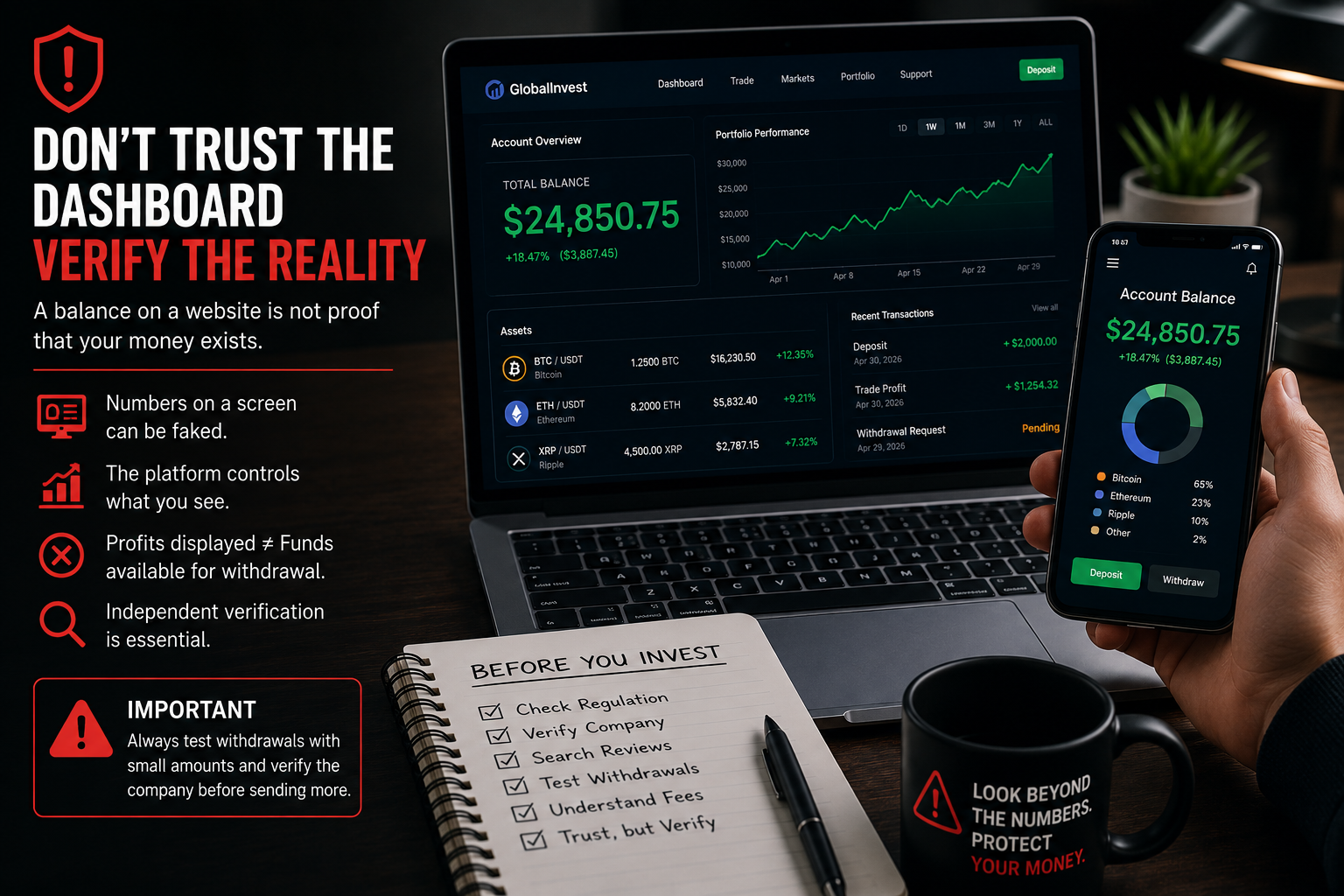
6\. Don't Trust the Dashboard Alone
This is extremely important.
Numbers displayed inside an investment account are not independent proof that the underlying assets or profits exist.
A website operator can potentially display whatever balance they choose.
Someone might deposit $5,000 and later see:
ACCOUNT BALANCE: $24,850
That number alone does not establish that $24,850 is actually available for withdrawal.
7\. Look Closely at the Withdrawal Process
Withdrawal problems can reveal important warning signs.
Be cautious if the platform suddenly demands additional payments such as:
• withdrawal fees • taxes • verification fees • security deposits • AML fees • liquidity fees • account upgrades • processing fees
before supposedly releasing your existing balance.
Do not automatically send another payment.
Independently verify the demand.
8\. Watch for the Never-Ending Fee Pattern
One particularly concerning pattern is:
You request withdrawal.
↓
Platform requests a fee.
↓
You pay.
↓
Another fee appears.
↓
You pay again.
↓
Another problem suddenly appears.
This cycle can continue until the victim stops sending money.
If each payment creates another unexpected requirement, stop and investigate.
9\. Research the Platform Outside Its Own Website
Do not base your decision entirely on information controlled by the company.
Search independently for:
• regulatory warnings • complaints • news reports • discussions • company-registration information • domain information • reports from other users
But remember:
Online reviews can also be manipulated.
Fake positive reviews and fake testimonials exist.
Use several independent sources rather than trusting one review website.
10\. Be Careful With Testimonials
A website showing photographs of happy investors does not prove those people are real customers.
Testimonials can be:
• fabricated • copied • purchased • generated • taken from unrelated websites
Treat testimonials as marketing, not independent verification.
11\. Check the Contact Information
Look at the company's contact details.
Ask:
Does the physical address exist?
Does the address actually belong to this company?
Does the telephone number work?
Does the email use the company's domain?
Does the legal company name match the investment platform?
Inconsistencies deserve further investigation.
12\. Watch for Pressure to Deposit More
Be cautious when an “account manager” constantly encourages larger deposits.
Examples include:
“This opportunity ends tonight.”
“You need another $10,000 to qualify.”
“You're about to miss the biggest trade of the year.”
“Borrow the money and repay it after your profit.”
Pressure and artificial urgency can prevent careful verification.
13\. Be Extra Careful When Cryptocurrency Is Required
Cryptocurrency itself is not evidence of a scam.
However, cryptocurrency transfers can be difficult to reverse.
Before transferring cryptocurrency, verify:
• who controls the receiving address • why cryptocurrency is required • which company you are dealing with • whether the platform is legitimately operating • whether the recipient information makes sense
Never provide your wallet seed phrase or private key.
14\. Never Install Remote-Access Software for an Investment Adviser
Be extremely cautious if someone involved with an investment asks you to install software allowing them to control your computer or phone.
Do not give strangers remote access to:
• banking • cryptocurrency exchanges • email • wallets • financial accounts
If remote access has already been provided, secure the affected accounts and device promptly.
15\. Check Before Sending a Large Deposit
Even if an initial small transaction appears successful, do not assume this proves the platform is legitimate.
A small withdrawal or apparent early profit may create confidence and encourage a much larger deposit.
Continue independently verifying the platform before increasing your exposure.
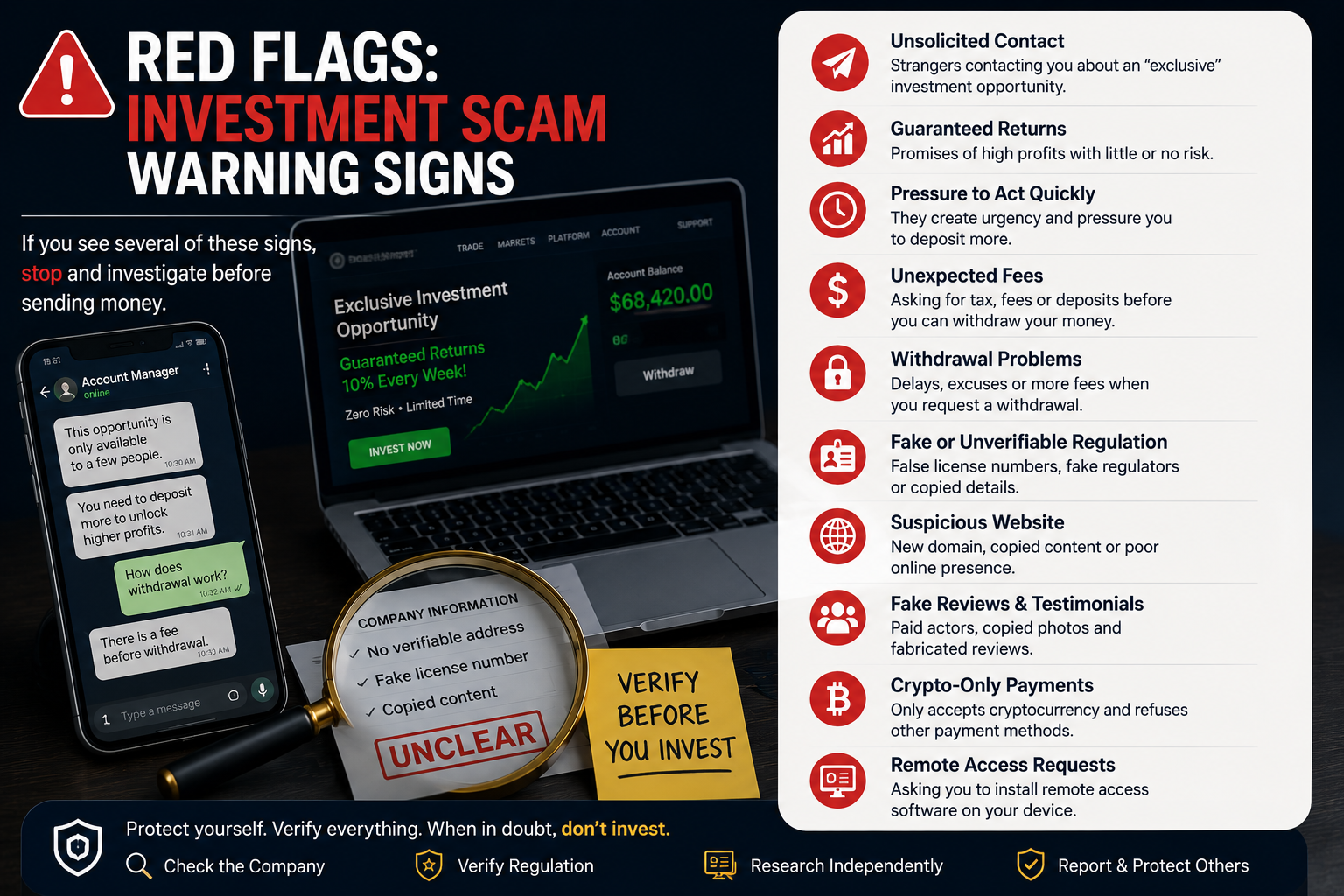
Red Flags Checklist
Before investing, stop and investigate if several of these appear together:
✓ unsolicited investment contact
✓ guaranteed returns
✓ pressure to act quickly
✓ unusually high profits
✓ unclear company ownership
✓ unverifiable regulation
✓ cryptocurrency-only deposits
✓ constant pressure to deposit more
✓ withdrawal restrictions
✓ unexpected withdrawal fees
✓ additional “tax” payments
✓ requests for remote access
✓ requests for seed phrases or private keys
✓ inconsistent company information
Already Sent Money? What Should You Do?
If you have already transferred money and now suspect the platform may be fraudulent, avoid panicking and sending additional payments.
Start preserving evidence.
Keep:
• website addresses • screenshots • transaction records • bank statements • cryptocurrency transaction hashes • wallet addresses • emails • WhatsApp conversations • Telegram conversations • usernames • phone numbers • withdrawal requests • additional payment demands
Contact relevant financial institutions or cryptocurrency services promptly where appropriate.
You can also document the incident through ScamGuard Pro so the information is organised in one place.
\## Search Before You Send
If you are investigating a platform, search available scam reports for its:
• company name • website/domain • wallet address • telephone number • other identifying information
Remember that finding no report does NOT prove a platform is legitimate.
A fraudulent operation may be new or simply not previously reported.
\## Frequently Asked Questions
Does HTTPS mean an investment website is legitimate?
No.
HTTPS means the connection between your browser and the website is encrypted. It does not establish that the people operating the website are trustworthy.
Can a scam investment website appear on Google?
Yes.
Appearing in search results does not by itself prove legitimacy.
Does a successful small withdrawal prove a platform is legitimate?
Not necessarily.
Continue independently verifying the company before sending substantially more money.
Can investment-platform reviews be fake?
Yes.
Do not rely exclusively on testimonials or reviews when making a financial decision.
Is cryptocurrency payment proof of a scam?
No.
Many legitimate businesses use cryptocurrency.
The important issue is the overall circumstances, identity of the recipient and legitimacy of the service.
What if the platform wants a fee before releasing my withdrawal?
Do not automatically send additional money.
Unexpected fees, taxes or deposits required to unlock an existing balance should be independently investigated.
Final Takeaway
The best time to investigate an investment platform is before sending money.
Do not allow impressive dashboards, account managers, testimonials or displayed profits to replace independent verification.
Check the company.
Check the regulator.
Check the exact domain.
Research independently.
Understand how withdrawals work.
And if something does not add up, stop before sending additional funds.
Taking an extra hour to investigate a platform can be far easier than trying to understand where your money went afterwards.
Stay alert: legitimate organisations will never ask you for your password, private key, seed phrase or a one-time passcode. If something feels off, stop, verify independently, and avoid sending further funds.
Scam alerts
Stay ahead of new scam tactics
Get practical fraud warnings, new ScamGuard Pro investigations and safety guides delivered to your inbox.
No spam. Unsubscribe anytime.