Bitcoin is a legitimate technology and a widely traded asset. Most people who use it are not criminals, and being asked to pay in Bitcoin does not automatically mean you are being scammed.
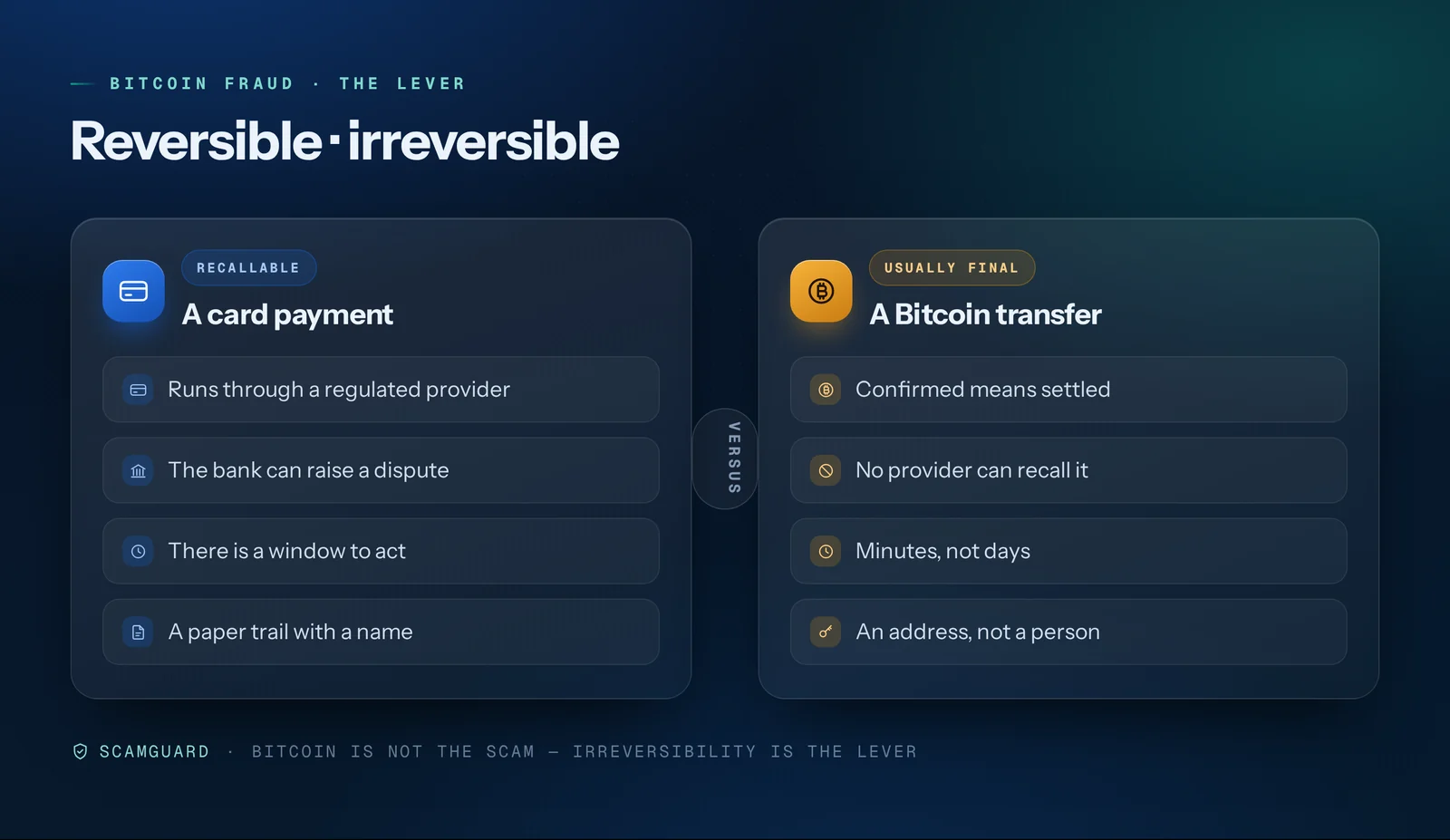
What makes Bitcoin attractive to fraudsters is something more specific: once a transfer is confirmed on the network, there is usually no central authority that can reverse it. A card payment can be disputed. A bank transfer can sometimes be recalled. A confirmed Bitcoin transfer generally cannot.
That single property changes the balance of risk. It means the checks you do before you send matter far more than anything you can do afterwards.
This guide walks through ten warning signs, breaks down the two mechanisms behind most Bitcoin fraud, and gives you a checklist you can run before you send anything.
Not sure about a wallet address, website or "trader"?
Search ScamGuard to see whether other people have already documented the same name, platform or wallet address.
10 Bitcoin scam warning signs
No single sign proves fraud on its own. The more of them you can tick, the more reason you have to stop and verify before any money moves.
1. Guaranteed Bitcoin profits
Bitcoin's price moves in both directions and nobody controls it. Anyone promising a guaranteed daily percentage, a fixed weekly return, or "no-loss" trading is describing something that does not exist in a real market.
What to do: treat the word guaranteed as the end of the conversation, not the start of one.
2. Someone offers to trade Bitcoin for you
An account manager, a "signals" group, a mentor from a comment section — the offer is usually the same: give them your money, or the access to trade it, and they will grow it for you.
Managing other people's money is a regulated activity in most countries. Someone who found you through a direct message and cannot be traced to a licensed firm is not accountable to anyone.
What to do: check whether the person or firm appears on your national regulator's public register, using the regulator's own website rather than a link they send you.
3. Fake Bitcoin investment dashboards
This is the mechanism behind the largest losses. You are given a login to a platform that looks professional and shows your balance growing. It feels like proof. It is not.
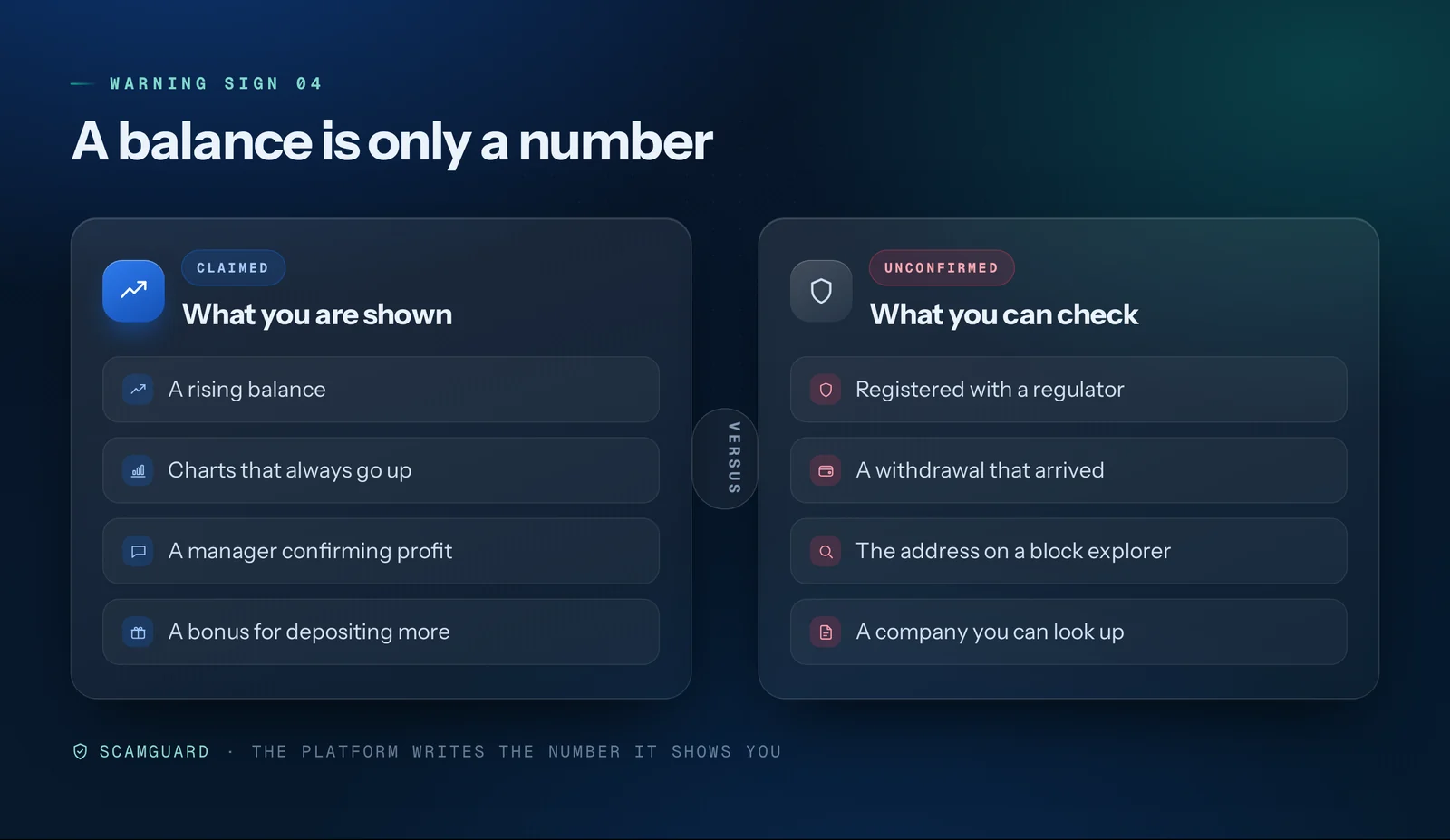
A dashboard is a display, controlled entirely by whoever built it. The only meaningful evidence is what you can confirm away from their website: a regulator entry, a company you can identify, and a withdrawal you have actually received.
What to do: before adding more funds, ask what you could confirm about the platform if their website disappeared tomorrow.
4. "Send Bitcoin and we'll double it"
Doubling offers spread through hacked accounts, comment replies, livestream overlays and messaging groups. The pitch is always urgent, always time-limited, and always requires you to send first.
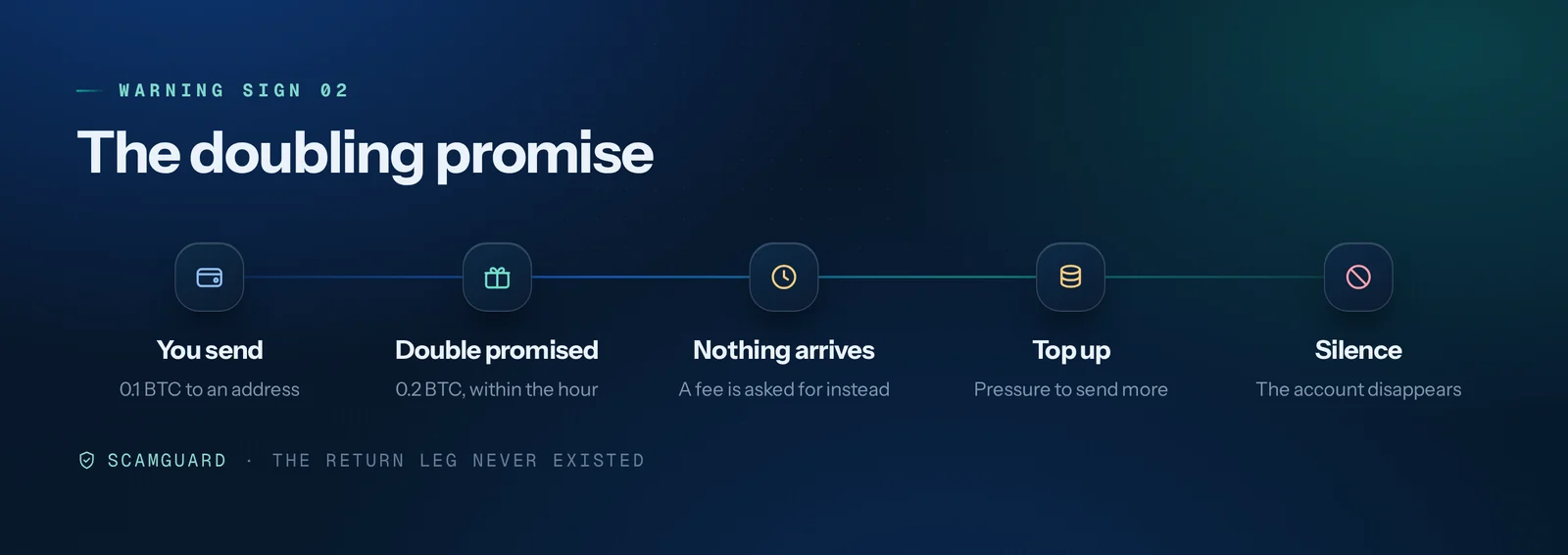
There is no mechanism by which sending Bitcoin to a stranger creates more Bitcoin. If a return leg existed, the person offering it would simply do it themselves.
What to do: never send funds to an address in order to receive a larger amount back. There is no version of this that works.
5. Withdrawal fees, taxes or unlock payments
You try to withdraw, and suddenly a payment is required first: a "release fee", a "liquidity deposit", a "tax clearance", a "verification charge".
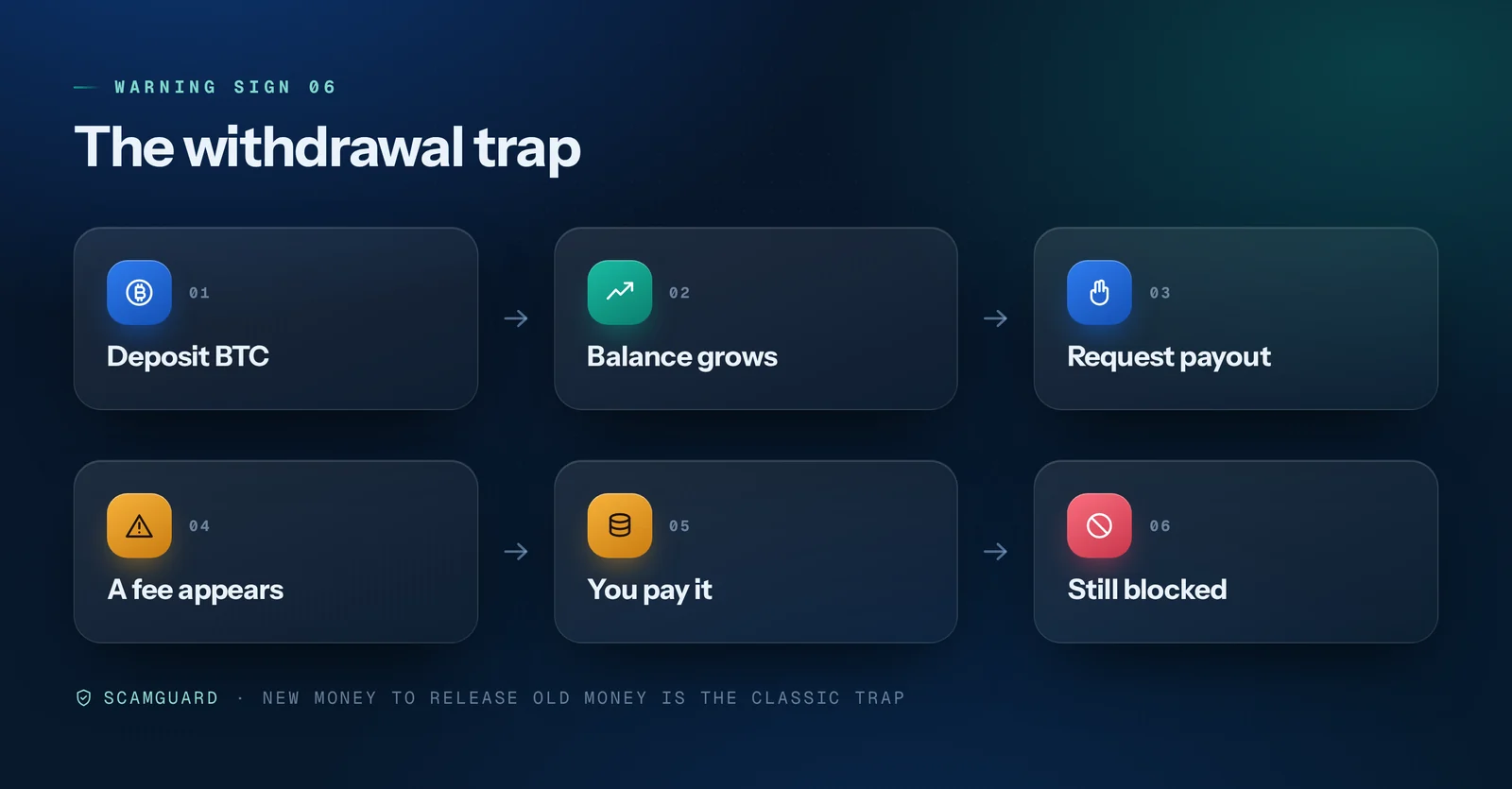
Legitimate platforms deduct costs from the balance you hold. They do not require a fresh deposit to release funds they say are already yours. Once you pay one fee, a second usually appears.
What to do: stop at the first fee request. Paying it is what turns a paper loss into a larger real one.
6. Bitcoin giveaways that require a payment
A giveaway that asks for a "processing fee", a "wallet activation payment" or a small deposit to confirm your address is not a giveaway. Genuine promotions do not require you to pay to receive.
What to do: any request for money attached to free money is the scam itself.
7. Fake celebrity or influencer endorsements
Scammers clone the accounts of well-known figures, generate video and audio that imitates them, and run adverts claiming that a public person endorses a trading platform. The name creates instant, borrowed credibility.
What to do: check the claim on the person's genuine, verified channels. If the endorsement only exists inside the advert, it does not exist.
8. Romance and Bitcoin investment together
A relationship builds over weeks or months, then an investment opportunity appears — often described as a family strategy or a private platform. The affection is the setup; the platform is the mechanism.
What to do: if you have never met someone in person and they are guiding your investments, treat it as an investment scam regardless of how genuine the relationship feels. Our romance scam warning signs guide covers the pattern in detail.
9. Pressure to move to Telegram, WhatsApp or a private channel
Moving the conversation off a platform removes moderation, reporting tools and any record the platform would keep. It also makes the account easy to delete.
What to do: be cautious about financial discussions that must happen in a private channel, especially when a group is full of people posting profit screenshots.
10. Requests for seed phrases, private keys, passwords, OTPs or remote access
This is the clearest line in the whole article. A seed phrase is your wallet. A private key is your wallet. A one-time code is your account. Remote-access software hands over your screen and often your session.
No genuine support agent, exchange, wallet provider, tax office or police officer will ever ask for them.
What to do: never type, photograph, read out or paste a seed phrase or private key anywhere. If you already have, move any remaining funds to a new wallet immediately.
Recognise any of these signs?
Documenting a suspicious platform, wallet address or "account manager" on ScamGuard helps build a public record other people can search before they pay. Reporting does not guarantee that funds are recovered.
The Bitcoin doubling scam — see the pattern
Strip away the branding and the doubling scam has one shape. You send, they promise, nothing comes back, and every message afterwards is designed to extract a second payment.
- You send. A first transfer, usually small enough to feel like a test.
- A return is promised. Often with fabricated confirmation screenshots or a "processing" page.
- Nothing arrives. Instead, a network fee, a tax or a verification payment is required.
- Pressure increases. A deadline, a bonus for topping up, or a claim that your transfer is stuck and needs unlocking.
- Contact ends. The channel is deleted, the account is renamed, and the address stops responding.
Fake Bitcoin investment platform — what you see vs what you can verify
The hardest part of a fake platform is that it behaves exactly like a real one, right up until you try to take money out. Small withdrawals sometimes succeed early on, precisely so that a larger deposit feels safe.
Useful questions to separate display from evidence:
- Is the company named, with a registration number you can look up yourself?
- Does the firm appear on your national regulator's public register?
- Have you completed a withdrawal and seen the funds arrive in your own account?
- Do the contact details resolve to a real, verifiable business?
- Was the platform introduced by someone you met online who you have never met in person?
If the only evidence is on their website, you do not yet have evidence.
Before sending Bitcoin: 7-point safety check
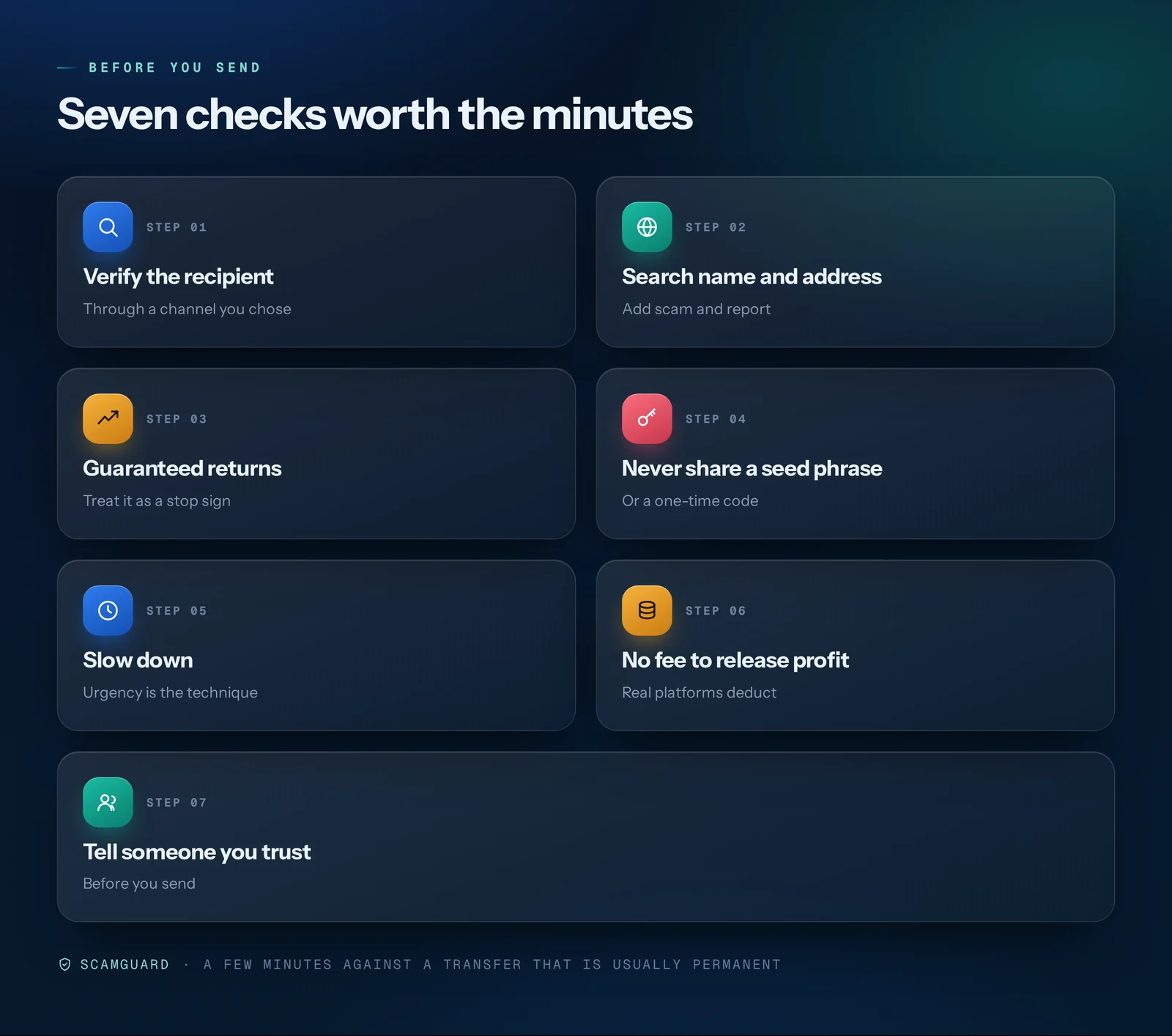
- Verify the recipient independently through contact details you find yourself.
- Search the name, website and wallet address before you pay, not after.
- Treat guaranteed returns as a stop sign. Certainty is a sales tactic.
- Never share seed phrases, private keys, passwords, one-time codes or your screen.
- Slow down when you are being rushed. Deadlines exist to prevent checking.
- Never pay a fee to release your own profit.
- Tell one person you trust before you send.
Run the check before you pay
Search ScamGuard for the website, wallet address or name you were given, and see whether anyone has already documented it.
If you already sent Bitcoin
Being targeted by a well-rehearsed scam is not a failure of intelligence. What matters now is limiting further loss and preserving what you have.
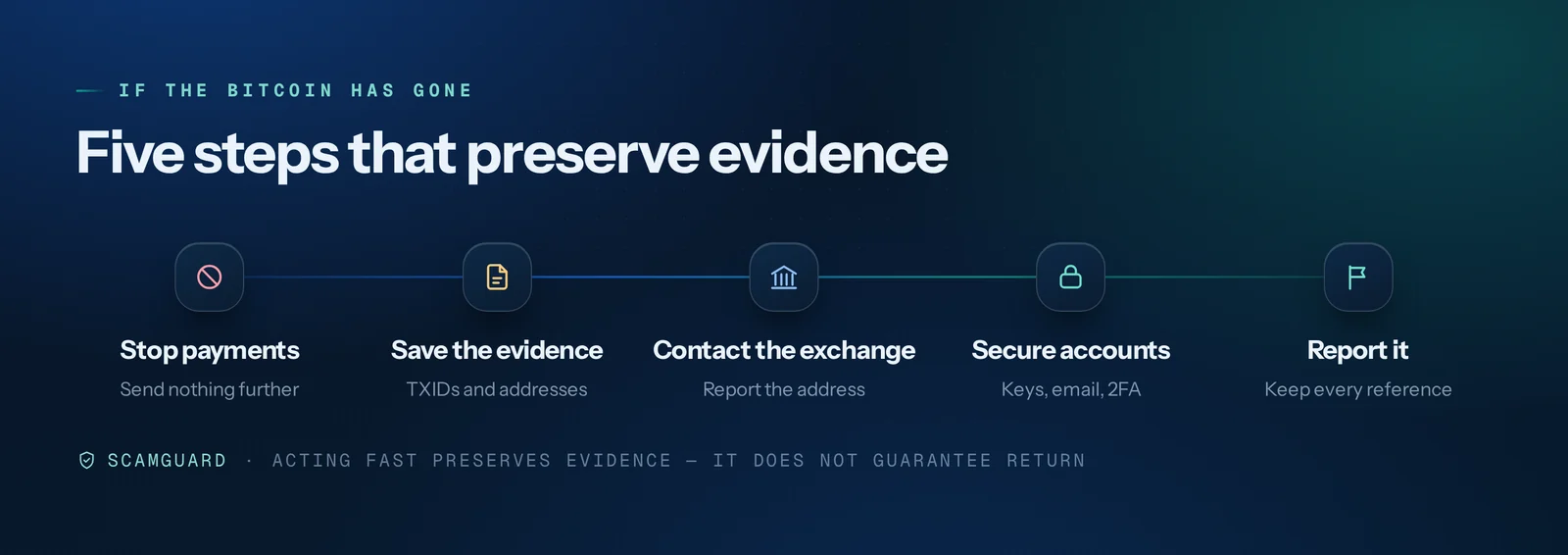
- Stop payments. Send nothing further, including any "final" fee framed as the last step.
- Save the evidence. Transaction IDs, wallet addresses, platform URLs, chat logs, emails, account names and screenshots of the dashboard while you still have access.
- Contact the exchange or payment provider you bought through, as early as you can.
- Secure your accounts. Change passwords, turn on two-factor authentication for email and exchanges, and remove any remote-access software you were asked to install. If a seed phrase was shared, move remaining funds to a new wallet.
- Report it. Report to your national fraud or cybercrime body, to the platform where you were contacted, and document the incident on ScamGuard so the details are searchable by others.
Frequently asked questions
Can Bitcoin transactions be reversed?
Generally no. Once a transfer is confirmed on the network there is no central party who can undo it. In limited cases, funds sent to an account at a regulated exchange may be frozen if that exchange is notified quickly, which is why contacting them early matters.
Does being asked to pay in Bitcoin mean it is a scam?
No. Bitcoin is used for many legitimate purposes. It is a reason to verify more carefully, because the payment is hard to undo, not proof of fraud on its own.
Are Bitcoin recovery services real?
Treat unsolicited recovery offers as fraudulent, particularly any that require an upfront fee, and especially if they contact you after you have already reported a loss. Legitimate help comes through your bank, your exchange, and official reporting bodies.
Is it safe to share my wallet address?
A receiving address is public information and can be shared. A seed phrase, recovery phrase or private key must never be shared with anyone, for any reason.
Why did my small withdrawal work but the large one did not?
Allowing a small withdrawal early is a common tactic. It creates evidence that the platform "pays out" and encourages a much larger deposit, which is then blocked behind fees.
Should I report a Bitcoin scam even if the money is gone?
Yes. Reporting creates a record that others can search before they pay, and gives investigators and platforms data about the addresses and websites involved. It does not guarantee that money is recovered.
Help protect the next person
Every documented wallet address, website and tactic makes the next person's search more useful. Report what happened to you, or check the database before you send anything.
Stay alert: legitimate organisations will never ask you for your password, private key, seed phrase or a one-time passcode. If something feels off, stop, verify independently, and avoid sending further funds.
Scam alerts
Stay ahead of new scam tactics
Get practical fraud warnings, new ScamGuard Pro investigations and safety guides delivered to your inbox.
No spam. Unsubscribe anytime.